
Why Your Website Gets Traffic but No Demo Requests
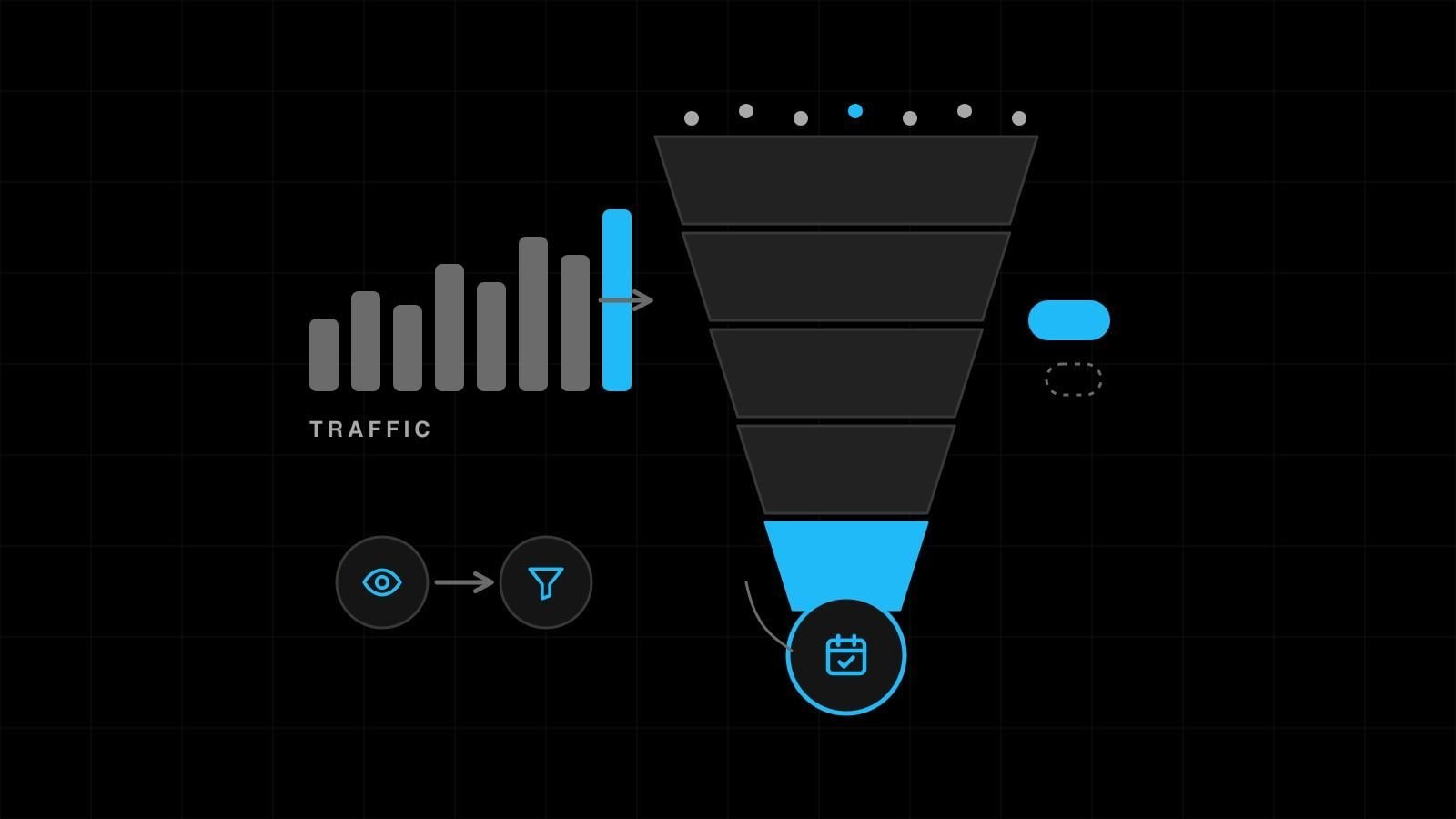
Short answer: A site with traffic and no demo requests usually has one of four problems: the wrong visitors, a message that does not match why they came, too little proof or too much friction between interest and a request. Diagnose them in that order, and make sure you can see where visitors drop off before you redesign anything.
Analytics shows a healthy line of visitors. The demo requests inbox stays quiet. That gap is uncomfortable, because traffic feels like progress. But traffic is only people arriving. A demo request is a person deciding that talking to you is worth their time.
Is the traffic worth converting?
Start with who is visiting and why. Group your traffic by source and by the page people land on.
| Source | Typical intent | What to check |
|---|---|---|
| Blog posts found on search | Learning | Are visitors your buyers, or students and job seekers? |
| Branded search (your name) | Evaluating you | Do they find proof and a clear next step? |
| Non-branded product searches | Comparing options | Does the page answer "is this for me?" fast? |
| Paid ads | Depends on the ad | Does the ad promise what the page shows? |
| Social and referrals | Curiosity | Is there a softer step than "book a demo"? |
A blog can attract large numbers of readers who will never buy. That is not a failure of the blog; it is a mismatch between its topic and your buyers. Compare where demo requests do come from, and where visitors from your ideal customers land.
Does the message match why they came?
A visitor decides within seconds whether a page is for them. Read your top three landing pages as a stranger:
- Can you tell what the product does and who it is for from the first screen?
- Does the headline describe a problem the visitor recognises, in their words?
- Does it match the ad, search or link that brought them?
If someone searched for "inventory software for small pharmacies" and lands on a headline about "transforming business operations", the page asked them to translate. Most will not.
What proof stands between interest and a request?
A request for a demo is a commitment of time. Buyers look for evidence before they give it:
- Customers who look like them, named with permission
- Specific outcomes, described honestly and with context
- Screens or a short walkthrough of the product, not only claims
- Security, privacy and support information appropriate to the product
- Clear information about what happens in a demo and how long it takes
Do not invent testimonials, logos or statistics. If you have limited proof, say what you do have: how long you have worked on the product, the problems it solves, the way you support customers, and offer a way to try or see it that does not require a sales call.
How much friction sits in the demo path?
Walk the path yourself on a phone:
- How many clicks from the homepage to the request?
- How many fields does the form have? Does it ask for information you do not need to schedule a conversation?
- Is the button label specific ("Book a 20-minute demo") or vague ("Submit")?
- Does it say what happens next?
- Are there alternatives for people who are not ready: a recorded demo, a short trial, a document, a chat?
- Does the form actually work, and does someone receive the request?
Broken forms and lost notifications are surprisingly common, and they are worth ruling out first.
Are you offering only one way to take the next step?
Some visitors are ready to talk. Many are not. A page with a single "Book a demo" button asks all of them for the biggest step. Offer a ladder: a short product tour, a downloadable guide, a comparison page, a newsletter, and a demo request for those who are ready. In India, add a phone or WhatsApp route; many buyers prefer to speak or message than to fill a form.
Can you see the funnel?
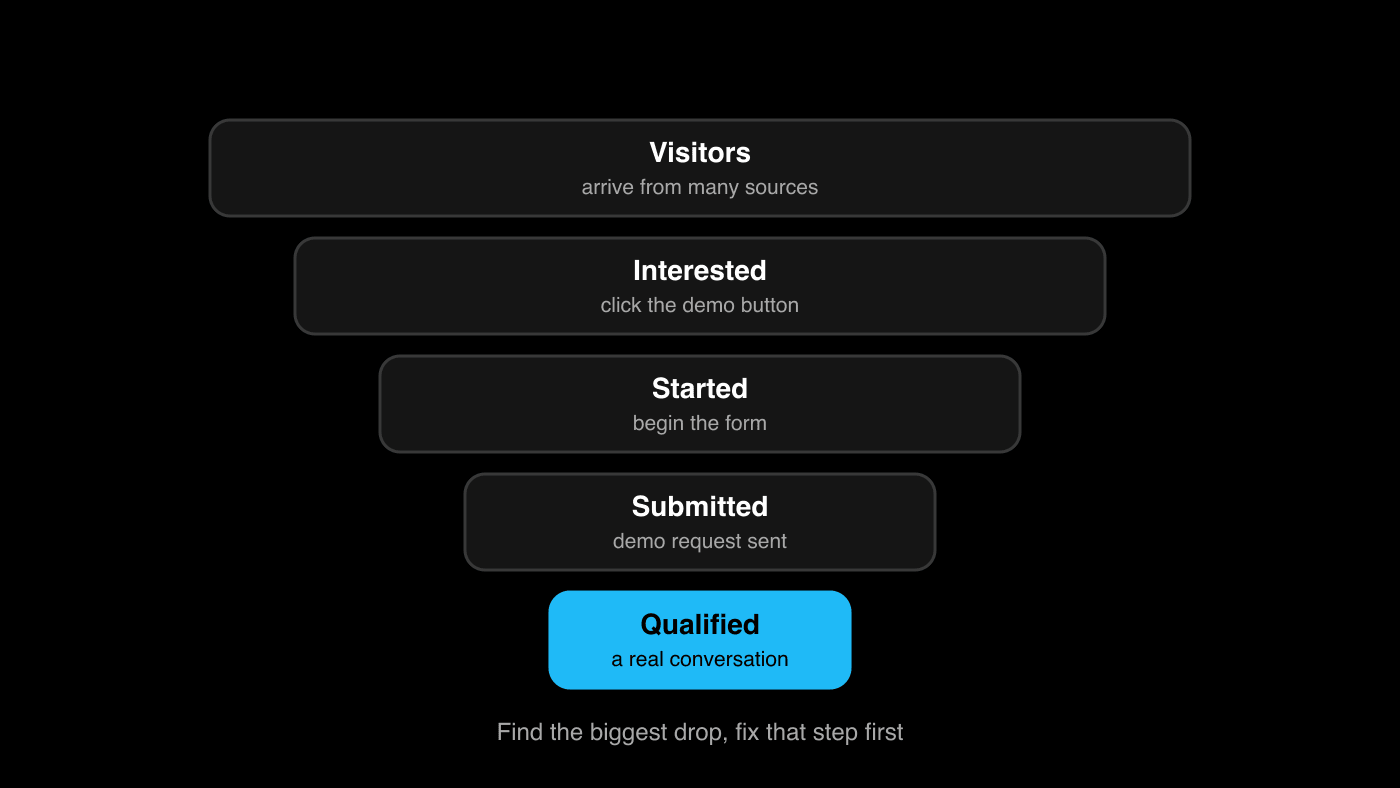
You cannot fix what you cannot see. Set up analytics so you can answer, for each landing page: how many visitors, how many clicked the demo button, how many started the form, how many submitted, and how many became qualified conversations. Track form submissions and important clicks as conversion events, and label the traffic source. Google Ads explains the idea in its conversion tracking overview; the same principle of recording valuable actions applies whichever analytics or ad tool you use.
Test the tracking itself: submit the form yourself, and confirm the event and the notification arrive.
Which fix should you make first?
Use the funnel to find the biggest drop:
- Few people click the button: the message, proof or button label is not persuading.
- Many click, few start the form: the form page is confusing or slow.
- Many start, few submit: the form is too long or asks for something sensitive.
- Many submit, few become conversations: the follow-up or qualification is failing.
- Mostly irrelevant visitors: the traffic sources need attention.
Change one thing at a time and give it enough traffic to show a difference.
What should you test first, and for how long?
Testing everything at once teaches nothing. Pick the change most likely to matter for the biggest drop in your funnel, and test one thing at a time: the headline, the proof, the button label, the form length or the page order.
Give each test enough visitors to show a real difference, and decide beforehand how you will judge it. With low traffic, small differences are usually noise, so favour larger changes such as a rewritten headline and offer over tiny tweaks like button colour. Record what you tested, what you expected and what happened, so the next person does not repeat it. If traffic is too low to test, use qualitative evidence instead: watch a few people use the page, ask recent buyers what almost stopped them, and read the questions your sales team hears.
What happens after the request?
Speed and clarity matter. Confirm the request instantly, propose times, and reply within the same working day. Ask one or two questions in advance so the demo is relevant. After the demo, send a written summary and a next step. If many requests arrive and few convert to customers, the problem may be lead fit rather than the website, so record why each opportunity was lost.
A software-company scenario (illustrative, not a client result)
Imagine a software company with steady blog traffic and few demo requests. Analytics shows most visitors read articles and leave. The homepage headline is a general slogan, the only button says "Contact us", and the form asks for company size, budget and eight other fields.
The team creates a landing page for its main use case that speaks in the customers' words, adds a short product walkthrough, replaces "Contact us" with "Book a 20-minute demo", shortens the form, adds a WhatsApp option and starts tracking button clicks and form steps. It also adds a calls-to-action inside articles that lead to the use-case page.
The number of visitors may stay the same. The share who take a next step, and the clarity of what is holding back the rest, improves.
Common mistakes
- Redesigning the site before finding where visitors drop off.
- Judging traffic by volume, not by who is visiting.
- One vague call-to-action for every visitor.
- Long forms and no explanation of what happens next.
- No testing of forms and notifications.
- Ignoring follow-up speed.
A demo-request checklist
- I know which sources bring my ideal customers.
- My landing pages match the intent that brought visitors.
- Each page shows what the product does and who it is for, above the fold.
- There is real proof, and I have not invented any.
- The demo button and form are specific, short and tested.
- There is a lower-commitment step for visitors not ready to talk.
- Clicks, form starts and submissions are tracked by source.
- Requests are answered the same day, with a clear next step.
Questions people ask about traffic that does not convert
Why is my website getting traffic but no leads?
Usually because the visitors are not the right ones, the message does not match their intent, proof is thin or the path to a request has too much friction. Tracking each step shows which one is at fault.
What is a good landing page conversion rate?
There is no single number that applies to every business, because it depends on traffic source, offer and industry. Compare your own pages over time and by source rather than chasing a benchmark.
Should I shorten my demo form?
Often, yes, if it asks for information you do not need to schedule a conversation. Test the change and measure both the number of submissions and their quality.
Do I need a lower-commitment call-to-action?
Many visitors are not ready for a sales conversation. A short product tour, guide or recorded demo gives them a way to continue without committing.
How can I tell whether the problem is traffic or the website?
Segment by source and landing page. If your ideal visitors land, engage and still do not act, the page or path is the issue. If most visitors are unrelated, the traffic sources need attention.
The short version
A conversion problem is a diagnostic problem. Check the traffic, then the message, the proof and the friction, measure each step and fix the biggest drop first. Make the next step clear, easy and matched to the visitor's readiness.
If you want your website's path to demo requests reviewed, talk to Advertizer. We can look at traffic, messaging, pages and tracking together.