
Why Your Digital Marketing Is Not Working: 15 Things to Check
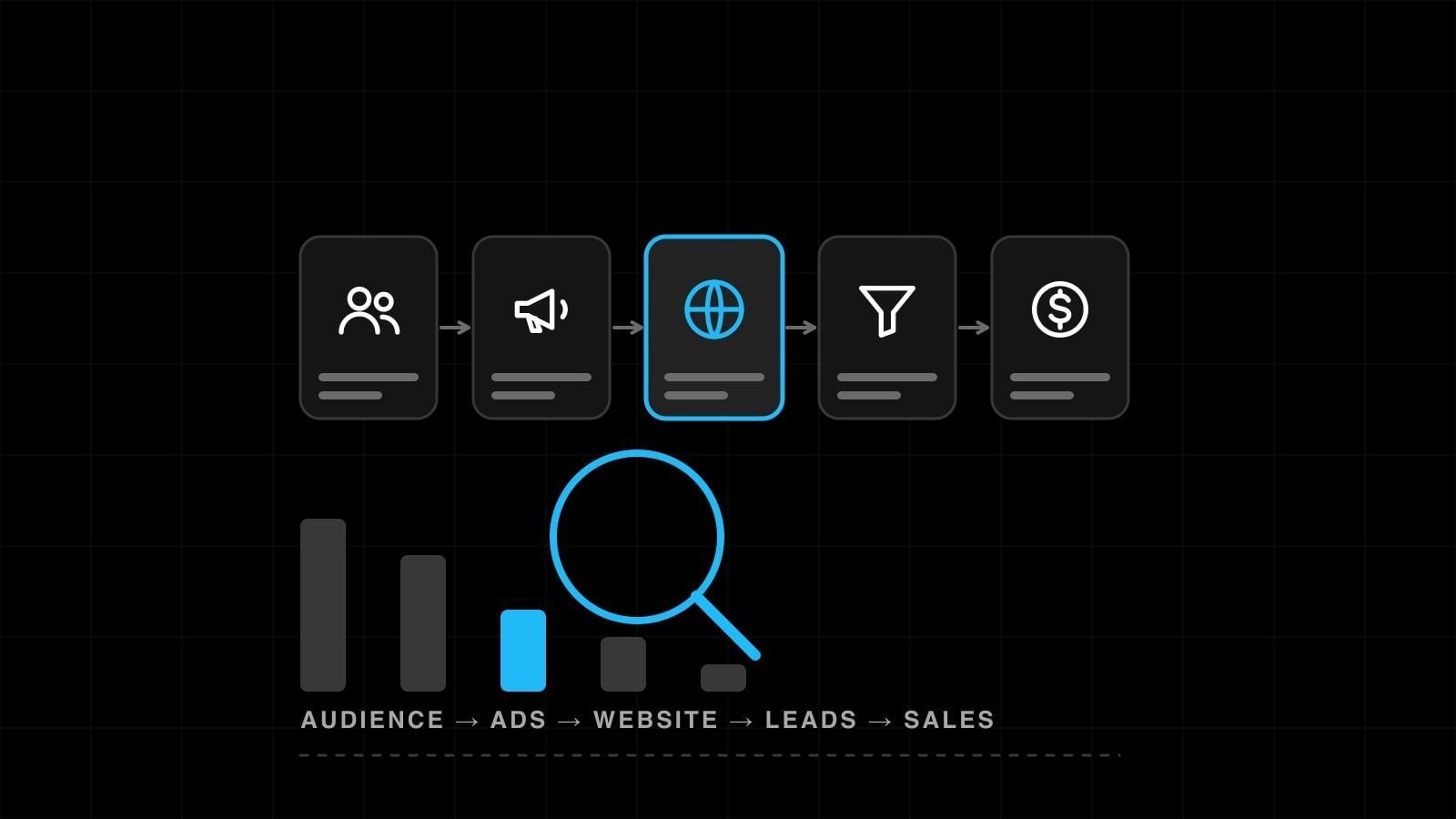
Short answer: When digital marketing "does not work", the cause is usually in one of fifteen places, and they are best checked in a fixed order: can you measure it, do the economics allow it, then audience, positioning, offer, creative, content, keywords, landing page, website, local visibility, follow-up, sales, retargeting and the review rhythm. Most problems surface within the first five checks.
"It is not working" can mean the ads get no clicks, the clicks bring no enquiries, the enquiries bring no sales, or the sales do not pay for the marketing. Each sits at a different stage, and each has different fixes. Guessing which one you have is how businesses change agencies, platforms and budgets without changing the result.
In what order should you check?
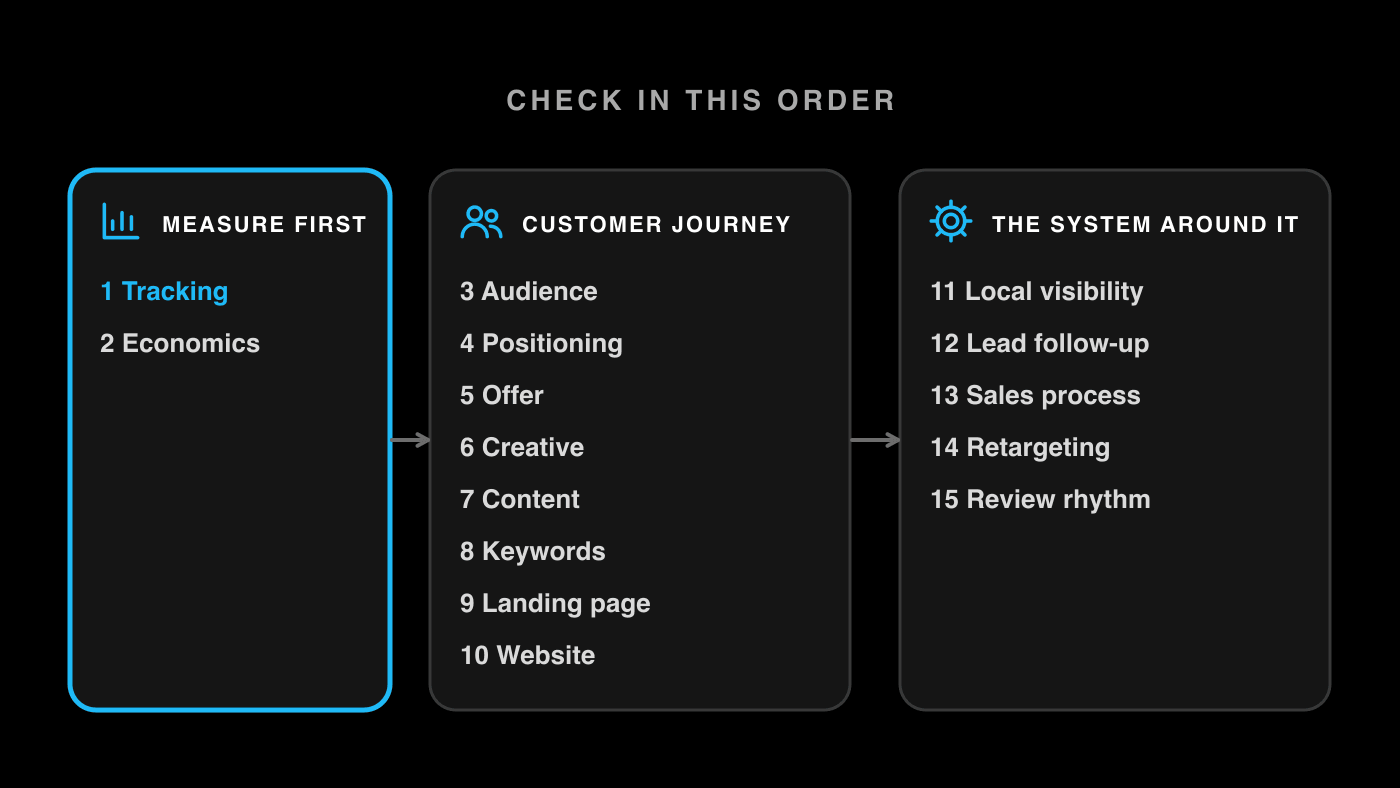
Work from the numbers to the message to the machinery.
- Measurement first, because without it every other conclusion is a guess.
- Economics second, because some campaigns fail on arithmetic, not creativity.
- Then the customer journey, in the order a customer meets it: audience, positioning, offer, creative, content, keywords, pages, follow-up.
- Finally the system around it: local visibility, sales, retargeting and how often you review.
Where does the problem sit?
Use the symptom to find the stage.
| What you see | Where to look first |
|---|---|
| Very few impressions or clicks | Checks 3, 6, 8 (audience, creative, keywords) |
| Plenty of clicks, few enquiries | Checks 5, 9, 10 (offer, landing page, website) |
| Enquiries, but wrong people | Checks 3, 4, 8 (audience, positioning, keywords) |
| Enquiries, but few sales | Checks 12, 13 (follow-up, sales process) |
| Sales, but not profitable | Checks 2, 15 (economics, measurement rhythm) |
| Results vary wildly | Checks 1, 14 (tracking, retargeting overlap) |
Check 1: Can you measure it?
Check that conversions are recorded: form submissions, calls, WhatsApp clicks, bookings, purchases. If your ad platform shows zero results while customers say they came from ads, your tracking may be broken. Google explains how conversions are recorded in its conversion tracking overview, and Meta describes redundancy and deduplication of events in its Conversions API best practices. Test by completing an action yourself and confirming it is counted.
Check 2: Do the economics allow it?
Work out gross profit per customer, the share of enquiries that become customers, and the most you can pay to win one. If your costs per customer exceed what a customer is worth, no amount of optimisation makes the campaign viable; the offer, price or margin needs to change. See how much a small business should spend on digital marketing for the method.
Check 3: Is the audience right?
Check who is actually seeing and responding: location, age, interests, search terms. Look for reach in areas you cannot serve, or audiences so broad they include people who could never buy. Narrow deliberately, then widen with evidence.
Check 4: Is your positioning clear?
Can a stranger tell in five seconds what you sell, for whom and why choose you? Vague positioning ("quality service") leaves buyers comparing on price alone. Write one sentence that names the customer, the problem and the difference, and see whether your ads and pages say it.
Check 5: Is the offer worth acting on?
An offer is a reason to act now: what the customer gets, at what price, with what risk removed. Weak offers produce attention without action. Check whether a competitor's offer is clearly better, or whether yours is not clear at all.
Check 6: Does the creative earn attention and set the right expectation?
Creative has two jobs: stop the scroll and promise something the page will keep. Review your best and worst ads. Do they show the product or place honestly? Is there a clear action? Does the promise match what a customer finds after clicking?
Check 7: Does your content help people decide?
Social posts, articles and videos should answer buyers' questions and build trust, not just fill a calendar. Look at which content earns saves, replies and enquiries, and make more of it. Content that attracts the wrong audience can be as unhelpful as none.
Check 8: Are the keywords and search terms right?
For search ads, read the search terms report. Are people searching for what you sell, or for jobs, free tools and unrelated products? Add negative keywords for wrong intent; Google's negative keywords guide explains how they match. For search optimisation, check that your pages target the questions your customers actually ask.
Check 9: Does the landing page match the promise and make one action easy?
Open your ad and follow it on a phone. Does the page match the ad? Does it load quickly? Is the next step obvious and easy? Pages that try to do everything convert poorly. See why a website gets traffic but no demo requests for a page-level diagnosis.
Check 10: Is the website easy to use and trustworthy?
Check speed, mobile usability, clear contact details, honest information and proof. Broken forms, slow pages and missing details quietly lose customers. Review the site as a stranger.
Check 11: Are you visible where local customers look?
For local businesses, Google Business Profile and local search are part of marketing. If you do not appear when people search nearby, ads may be doing all the work. Check the profile, reviews and consistency of details; why a local business is not showing on Google walks through it.
Check 12: Do leads get a fast, human response?
Measure the time from enquiry to first reply, and how often you follow up. Slow, generic replies waste the money spent to get the lead. Assign an owner to every enquiry and set a reply standard.
Check 13: Is the sales process turning enquiries into customers?
Track the stages after the enquiry: reached, qualified, quoted or visited, closed. Note where people drop out and why. Marketing may be working while the sales conversation, pricing or process is not.
Check 14: Is retargeting used sensibly, where appropriate?
Retargeting shows ads to people who already interacted with you. It can help remind and convert, but it can also overlap with other campaigns, annoy people or be restricted in sensitive categories such as health. Use small, specific audiences and check platform policies. It is a refinement, not a rescue.
Check 15: Are you measuring at the right rhythm and against the right numbers?
Review weekly for operations and monthly for decisions. Judge campaigns by cost per qualified lead, cost per customer and payback, not by clicks or followers. Give tests enough time to produce a signal before changing course, and change one thing at a time so you know what caused the difference.
How do you score yourself?
Go through the fifteen checks and mark each one green (verified and fine), amber (unsure) or red (a problem). Fix reds from the top of the list, and resolve ambers by measuring. Do not start with the check you find most interesting; start with the first red.
A service-business scenario (illustrative, not a client result)
Imagine a service business whose Meta ads produce many clicks and few calls. The diagnostic starts with measurement: calls are not tracked at all, so the campaign's results are invisible. Economics show that at the closing rate the owner assumed, the cost per customer would be too high. The audience covers the whole state. The landing page is the home page. Replies take a day.
Fixing them in order changes what happens: call tracking gives visibility, a local audience and a focused page raise relevance, and a same-day reply changes conversion. The owner also learns that the original economics need a better offer to work.
Common mistakes
- Blaming the platform or the agency before checking tracking.
- Changing several things at once.
- Judging results after a few days.
- Optimising for clicks or followers.
- Ignoring the sales stage after the enquiry.
- Assuming a bigger budget will fix a broken funnel.
The 15-point checklist
- 1 Conversions are tracked and tested.
- 2 Economics allow a profitable cost per customer.
- 3 The audience is local and relevant.
- 4 Positioning is clear in one sentence.
- 5 The offer gives a reason to act.
- 6 Creative earns attention and matches the page.
- 7 Content answers buyers' questions.
- 8 Keywords and search terms are relevant, with negatives in place.
- 9 The landing page matches the ad and makes one action easy.
- 10 The website is fast, clear and trustworthy.
- 11 Local visibility and profile details are accurate.
- 12 Leads get a fast, human reply.
- 13 The sales process is tracked and improved.
- 14 Retargeting is small, specific and policy-compliant.
- 15 Reviews happen on a schedule against the right numbers.
Questions people ask when marketing is not working
Why is my digital marketing not working?
Usually for one or more of these reasons: broken or missing tracking, economics that do not work, the wrong audience, a weak offer, a landing page that does not match the ad, slow follow-up or a sales process that loses enquiries. Checking them in order reveals which applies.
Why do my ads get clicks but no sales?
Clicks show attention. Sales depend on the offer, the page, the trust signals, the follow-up and the price. Check tracking first, then the landing page and follow-up.
How long should I wait before deciding a campaign has failed?
Long enough to collect meaningful results, which depends on your budget and volume. Define the test length and success measure in advance, and avoid changing several things at once.
Should I change my agency or platform?
Only after you have checked measurement, economics and the funnel. Changing provider without fixing a broken offer, page or follow-up usually repeats the result.
Can a bigger budget fix poor results?
Not if the funnel is broken. Extra spend on a leaking funnel wastes more money. Fix the weakest stage first, then scale what works.
The short version
Digital marketing rarely fails for one mysterious reason. Check the fifteen places in order, starting with tracking and economics, fix the first red, then re-measure. Progress comes from changing one thing at a time and judging it by customers, not clicks.
If you would like help working through this diagnostic on your own campaigns, talk to Advertizer. A business and digital growth consultation is designed for exactly this kind of review.