
How Much Should a Small Business Spend on Digital Marketing?
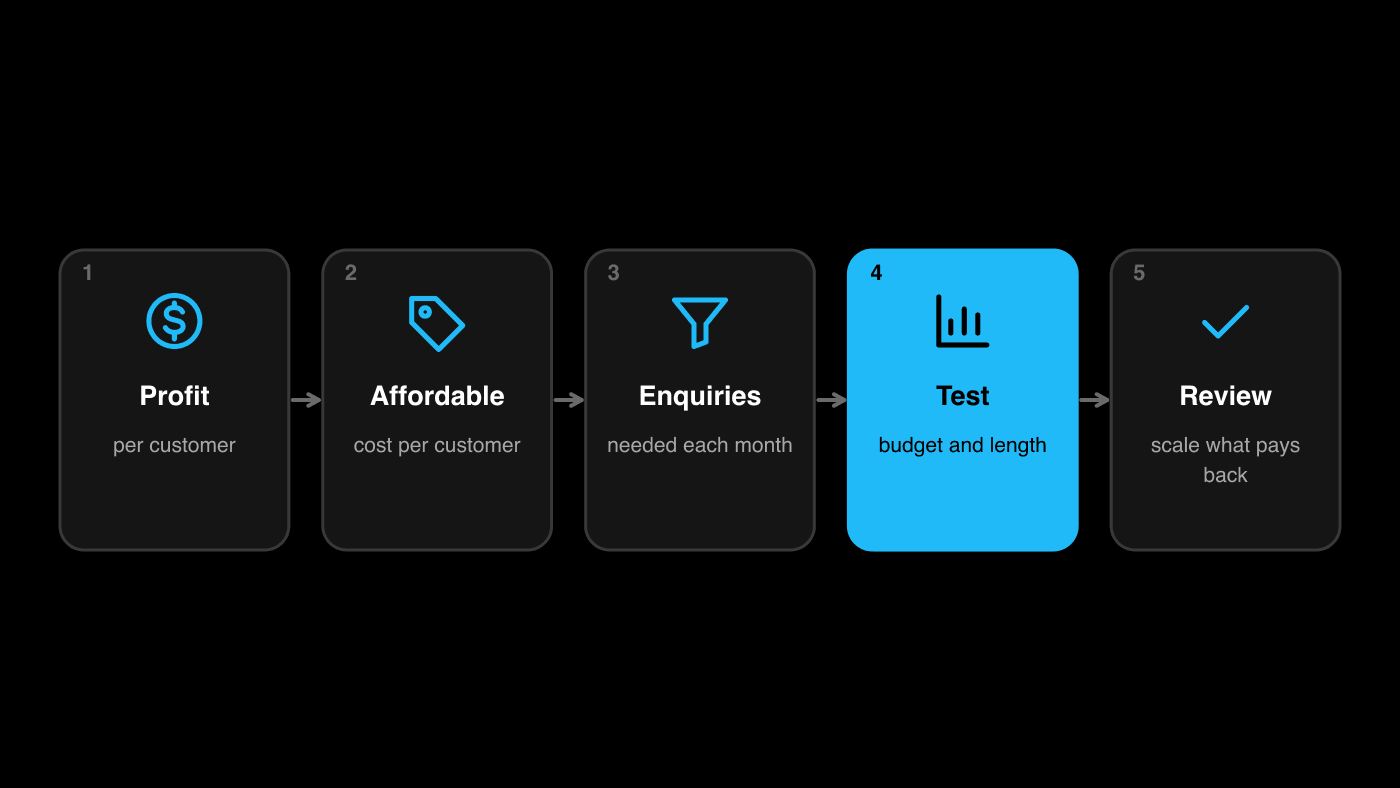
Short answer: There is no percentage of revenue that suits every small business. Set a marketing budget from your own numbers: the gross profit each new customer brings, the share of enquiries that become customers, how many customers you can actually serve, and how much you need to spend to learn what works. Start with a test you can afford to lose, then scale what pays back.
Most articles answer this question with a percentage of revenue. Percentages ignore what actually decides whether spending makes sense: how profitable a sale is, how many enquiries close, how fast customers return and how much capacity you have. A tea stall, a clinic and a machinery maker cannot share a budget rule.
This guide gives you a way to build your own answer, with examples that are clearly illustrative. The numbers in them are not benchmarks and not a promise of results.
Why do percentage rules fail?
A percentage of revenue tells you what other businesses might spend, not what you can profitably spend. It does not know:
- how much you earn on each sale after costs
- whether customers buy once or repeatedly
- whether you are new and need to be known, or established and need to convert
- whether you can serve more customers if the marketing works
Use a rule of thumb, if you like, only as a sanity check after you have done the working below.
What five numbers do you need?
- Average order value: what a typical customer pays for a typical purchase.
- Gross margin: the share of that value left after the direct cost of delivering it. Multiply the two to get gross profit per sale.
- Repeat value: how much gross profit a customer brings over the period you consider, if they come back. This is often called lifetime value.
- Conversion rate: of the people who enquire or visit, what share become customers. Use your own history, even if rough.
- Capacity: how many extra customers you can serve well each month.
If you do not know a number, estimate it, write it down as an estimate, and improve it as you gather data.
How do you work out what you can afford per customer?
The most you can pay to win a customer is less than the gross profit that customer brings over the period you count. How much less depends on your overheads, your cash position and how much risk you accept. Many owners set a target well below the maximum so there is room for profit and for mistakes.
This is the idea often called customer acquisition cost against lifetime value. It is a way of thinking, not a formula that works in every business, and the ratios quoted online vary. Pick a target that suits your margins and cash, and revisit it.
What does an illustrative calculation look like?
The following is an example only. The figures are invented to show the arithmetic, and use no currency on purpose.
| Step | Illustrative figure | How it is used |
|---|---|---|
| Average order value | 2,000 | What one sale is worth |
| Gross margin | 40% | Gross profit per sale = 800 |
| Repeat purchases in a year | 1.5 sales per customer | Gross profit per customer ≈ 1,200 |
| Share of enquiries that become customers | 1 in 5 | Each enquiry is worth ≈ 240 in gross profit |
| Willing to spend of that gross profit | Half | Affordable cost per enquiry ≈ 120 |
| Customers you can serve each month | 20 | Needs about 100 enquiries a month |
From these illustrative numbers, an affordable acquisition spend would be about 120 per enquiry, and reaching 20 new customers a month would need about 100 enquiries and a budget in the region of 12,000 for enquiries alone, before tools, creative and your time. Change any input and the answer changes. If only 1 in 10 enquiries closed, the affordable cost per enquiry would halve.
Notice what the calculation reveals: improving the closing rate, the margin or the repeat rate often raises your affordable budget more than finding cheaper clicks.
How do you set a testing budget?
Before you know your real numbers, you are buying information. Set a testing budget with three rules:
- Choose an amount you can lose without hurting the business.
- Run it long enough to learn. Ad platforms need time and enough results for patterns to be visible; a few days is rarely enough. Decide the length in advance.
- Define success before you start: for example, qualified enquiries at or below a cost you can afford, or a number of booked appointments.
At the end of the test, calculate your real conversion rate and cost per customer and compare with your working. Adjust the plan, not just the spend.
Where should the money go?
Split the budget between the things that make spending work and the media itself:
- Foundations: a website or landing page that converts, a Google Business Profile, tracking, and a way to answer enquiries fast. Spending on ads before these are ready wastes the media budget.
- Creative and content: photographs, video and copy that make people act.
- Media: ad spend on Meta or Google, sized to your test or plan.
- Follow-up: the time or tools that turn enquiries into customers.
For a business with existing customers and a working funnel, the balance shifts toward media. For a new business, foundations and creative often deserve a larger share at first.
How do Meta Ads and Google Ads budgets differ?
Both platforms let you set daily or overall budgets, and neither publishes a minimum budget that ensures results; what works depends on your market, competition, targeting and offer. Google Search costs depend on how many advertisers compete for the searches you want. Meta costs depend on the audience you choose and how relevant your ad is to them. Treat any published "average cost per lead" with caution: definitions of a lead, industries and countries differ widely.
Start each with a budget you can sustain, and use the results, not a benchmark, to decide whether to raise it. For the mechanics of tracking results, see Google's conversion tracking overview and Meta's Conversions API best practices.
What about agency fees and your own time?
Include them. A complete cost of marketing counts the ad spend, any agency or freelancer fees, tools, creative production and the time you or your team put in. Compare that total, not just ad spend, with the gross profit from customers the marketing brings. Advertizer's business and digital growth consultation exists to help owners plan this before they commit to execution.
When should you increase the budget?
Increase when three conditions hold: your numbers show customers coming in at a cost you can afford, you have capacity to serve more, and follow-up is not the bottleneck. Increase gradually and watch whether results hold. If cost per customer rises sharply as spend rises, you may be reaching the limit of a small audience or a weak offer.
When should you cut or pause?
Pause or change course when your tracking is broken, when the offer or page has a clear problem or when the cost per customer stays far above what you can afford after a fair test. Then diagnose the cause before spending more. Our guide on why your digital marketing is not working gives an ordered checklist.
Common mistakes
- Copying a percentage from an article or a competitor.
- Spending on ads before the website and follow-up are ready.
- Ending a test after a few days.
- Counting ad spend only, and ignoring fees, creative and time.
- Measuring enquiries, not customers.
- Raising the budget faster than you can serve customers.
A budget-planning checklist
- I know my average order value and gross margin, or have estimated them.
- I have estimated repeat value and conversion rate.
- I know how many new customers I can serve each month.
- I have worked out what I can afford to pay per customer.
- I have set a test budget, a test length and a success measure.
- My tracking and follow-up are ready before I spend on media.
- I count all costs, not only ad spend.
- I review results monthly and adjust.
Questions owners ask about marketing budgets
How much should a small business spend on marketing each month?
It depends on the value of a customer, your conversion rate, your capacity and how much you can afford to test. Work backwards from those numbers instead of using a fixed percentage.
What is a good Meta Ads or Google Ads budget to start with?
An amount you can afford to lose, run long enough to learn. There is no universal figure, and no platform promises results at any level.
Should new businesses spend more on marketing than established ones?
New businesses often need to invest in foundations and awareness, so they may spend a larger share of revenue for a period, but only as far as cash and risk allow. Established businesses can lean on repeat customers and referrals.
Is a percentage of revenue useful at all?
Only as a rough check after you have done the calculation from your own numbers. On its own it ignores margin, conversion and capacity.
Does the budget include agency fees?
It should. Count ad spend, fees, tools, creative and your own time when judging whether marketing pays back.
The short version
Build your marketing budget from your economics: what a customer is worth, how many enquiries become customers, how many you can serve and what a fair test will teach you. Start small, measure real results, count all costs and scale what pays back.
If you would like help working out a marketing plan and budget from your own numbers, talk to Advertizer. We can start with a growth consultation before any spending.