
Why Restaurant Ads Get Clicks but No Customers
Short answer: Restaurant ads usually fail between the click and the table. The audience may be too wide, the offer too weak, the landing page hard to use on a phone, or the campaign may be optimised for clicks instead of calls, orders and visits. Trace one customer from ad to table and fix the weakest link first.
A restaurant does not sell on a web page. It sells a table, a delivery, a booking or a walk-in. That single fact explains most "clicks but no customers" problems: the ads were built to produce visits to a website, while the business needed people in a chair.
What counts as a customer for a restaurant?
Before changing anything, decide what you are counting. For a restaurant, a useful list of actions is short:
- a phone call to the restaurant
- a tap for directions
- a WhatsApp message asking about a table or an order
- an online order or table booking
- a walk-in who mentions the offer
A click on an ad is none of these. It is an early signal, and it can be cheap precisely because it is easy. If your report shows clicks and impressions but none of the actions above, you are looking at a report that cannot tell you whether the campaign works.
Why do restaurant ads get clicks but no customers?
Eight things go wrong again and again. They appear in the order a hungry person meets them.
- The campaign chases clicks. Ad platforms optimise toward the objective you pick. If it is website traffic, you get people who click, not necessarily people who book.
- The location is too wide. People who live an hour away like the photo and never come.
- The timing ignores meals. An ad for dinner shown at 10 a.m. is easy to scroll past.
- The offer is not a reason to come now. Beautiful food photography alone rarely creates urgency.
- The ad promises one thing and the page shows another. A creative about a new menu that links to the home page is a broken promise.
- The page is hard to use on a phone. A menu as a heavy PDF, tiny buttons, no visible phone number.
- The next step takes effort. No tap-to-call, no map link, no WhatsApp.
- Nobody measures walk-ins. So the campaign looks like a failure even when some people arrive.
How do you trace the path from ad to table?
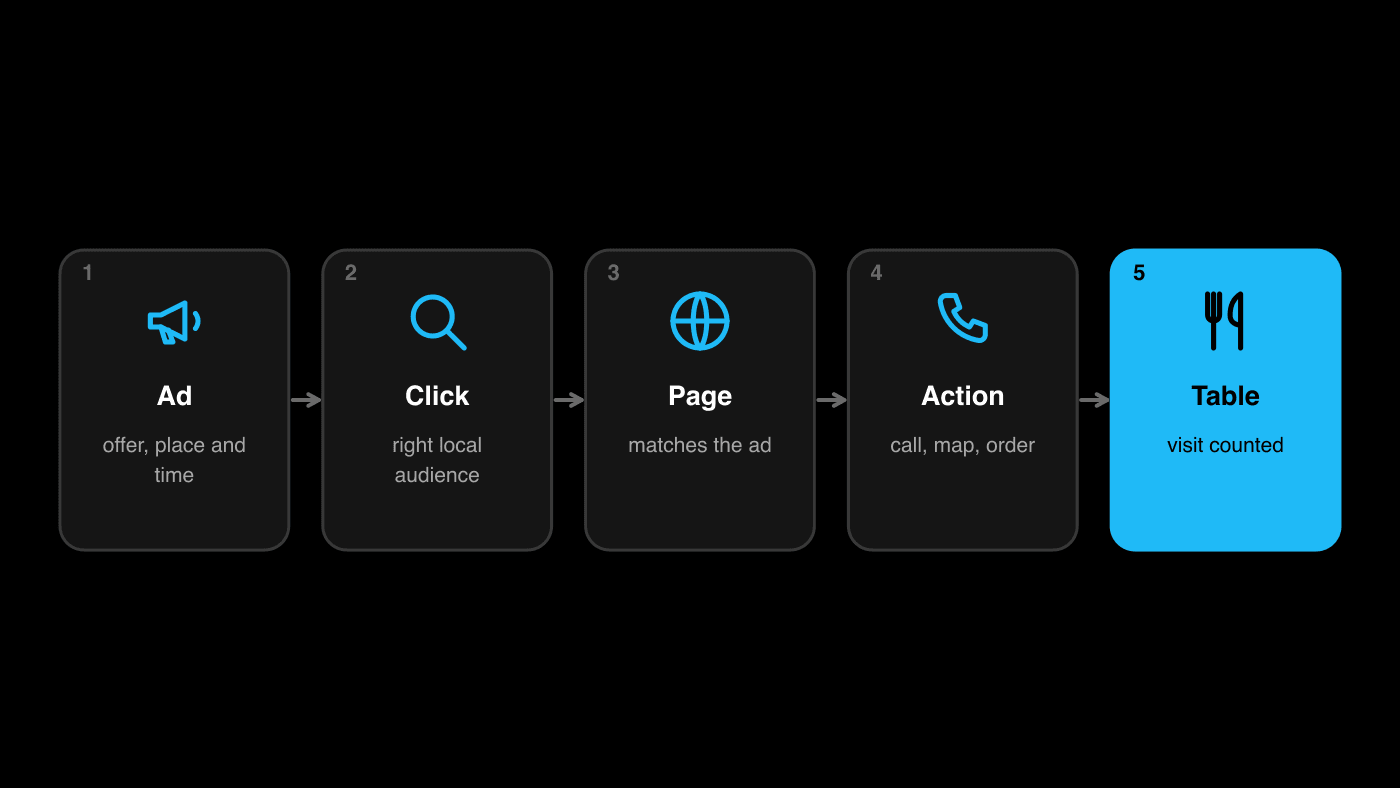
Draw the path on paper and test it on your own phone, with mobile data, standing outside your restaurant.
| Stage | Question to ask | What a leak looks like |
|---|---|---|
| Ad | Is the promise specific, local and timed? | Generic food photo, no offer, no place name |
| Click | Who is being shown this? | Reach in cities you cannot serve |
| Page | Does it match the ad, load fast and show the action? | Home page, slow menu PDF, no call button |
| Action | Can someone call, get directions or book in one tap? | Form with many fields, no WhatsApp |
| Visit | Did they arrive, and did we know it was the ad? | No offer code, staff never ask |
Fix the earliest broken stage first. Improving the ad while the page cannot be used on a phone only sends more people to a dead end.
Are you showing ads to the right area and the right hours?
Set the location around where a person can realistically reach you within the time they have. Use a tight radius or named localities, and add or exclude areas after you see where enquiries actually come from. Then look at when people decide. Lunch and dinner planning, weekends and match days all create moments where an ad is relevant. Schedule around them if your ad platform allows.
Advertizer's Cubic Cafe Rooftop case study is an example of this thinking: a hyperlocal approach that used recognisable local landmarks, student-focused storytelling and Meta ads timed around IPL and weekend peaks. The case study also gives the outcomes as reported by the client; read it there rather than relying on a summary.
Is the offer a reason to come today?
An offer does not have to be a discount. It has to give a decision a deadline or a specific reason: a weekday lunch combination, a table for a birthday group, a live-music evening, a seasonal dish. For a new cafe the reason can simply be a specific experience: the rooftop, the view, the study-friendly afternoon.
The ad should say who it is for, what they get, where and when. Hold the food photography to a standard where the dish looks like the dish that arrives. Disappointment on arrival costs more than the ad did.
What should the landing page do?
If the ad points to your website, the page must do one job. Restaurants usually need one of four:
- Order online: show the menu, a clear order button and delivery area.
- Book a table: a short form or a WhatsApp chat with details pre-filled.
- Visit: the address, a map link, opening hours, parking and a call button.
- Get an offer: what it is, how to claim it, and when it ends.
Test it on a phone. Buttons should be large, text readable without zooming, and the first screen should show what the ad promised. If a menu is a heavy PDF, replace it with a page that loads quickly. Our note on website development explains why the page an ad lands on matters as much as the ad.
Meta Ads or Google Ads for a restaurant?
They catch different moments. People searching on Google for a restaurant near them are already looking, so Google Ads and a well-kept Google Business Profile capture that intent. Meta's platforms, including Instagram, reach people who were not searching, which is useful for a new place, a new menu or an event. For a neighbourhood restaurant the strongest base is usually a complete, accurate Google Business Profile (see why a local business is not showing on Google), with Meta ads used to create demand around specific offers.
How do you count customers who walk in?
Some of your best customers will never click anything. Give them a way to be counted:
- Put a simple offer phrase in the ad that staff can recognise ("Ask for the rooftop lunch").
- Ask new customers how they heard about you and record the answer.
- Watch calls and direction requests in your Google Business Profile performance report alongside campaign dates.
- Use a WhatsApp click-to-chat that pre-fills a message such as the offer name, so enquiries are countable.
None of this is perfect. All of it is better than deciding from clicks.
Should you use remarketing?
Remarketing means showing ads again to people who already interacted with you, for example those who watched most of a video or opened your menu page. For a restaurant it can be useful at small scale, for example to remind recent menu-page visitors about a weekend offer. Keep the audience small and the message specific, and respect platform policies and privacy expectations. It is a later step, not a first fix.
Common mistakes
- Judging a campaign by cost per click.
- Running one generic ad for all areas and all hours.
- Sending traffic to the home page.
- Leaving out a phone number because "everyone uses the website".
- Changing the offer, the creative and the audience in the same week.
- Forgetting to tell the team an offer is running.
A checklist before you spend another rupee
- I know what action counts as a customer for my restaurant.
- My campaign objective matches that action.
- My location covers only areas people can reach.
- My ad names a specific offer, place and time.
- The page opens quickly on a phone and matches the ad.
- A person can call, get directions or message in one tap.
- Staff know how to recognise and record offer customers.
- I review calls, directions and orders weekly, not just clicks.
Questions restaurant owners ask about ads
Do Meta ads work for restaurants?
They can, especially for launches, events and offers, because they reach people who were not searching. Results depend on the offer, the local audience, the page and the follow-up. They are one part of a plan that also needs a good Google presence.
Is Google Ads better than Meta Ads for a restaurant?
Neither is better in general. Google can capture people who are already searching for food nearby; Meta can create interest in a place or an offer. Many restaurants start with a strong Google Business Profile and use Meta ads around specific offers.
Why do I get clicks but no calls?
Check the objective, the location and the page. A campaign aimed at website traffic rewards clicks. A slow or confusing page loses those clicks, and a missing call button removes the easiest action.
How much should a restaurant spend on ads?
There is no fixed amount that suits every restaurant. Start from what a customer is worth to you and how many you need, then test a small budget for long enough to learn. Our guide on small business marketing budgets shows how to work it out.
How can I tell if ads brought walk-ins?
Use an offer phrase staff can recognise, ask new customers how they found you, and compare calls and direction requests with the days your ads ran. It is rough, but far better than guessing.
The short version
If clicks are not becoming customers, stop looking at the ad alone. Decide what a customer is, tighten the audience and timing, make the offer a reason to come now, match the page to the ad, make one tap enough to act, and find a way to count walk-ins. Then adjust one thing at a time.
If you would like help tracing your restaurant's path from ad to table, talk to Advertizer. We look at the ad, the page, the profile and the tracking together.