
How Hotels Can Get More Direct Bookings Through Digital Marketing
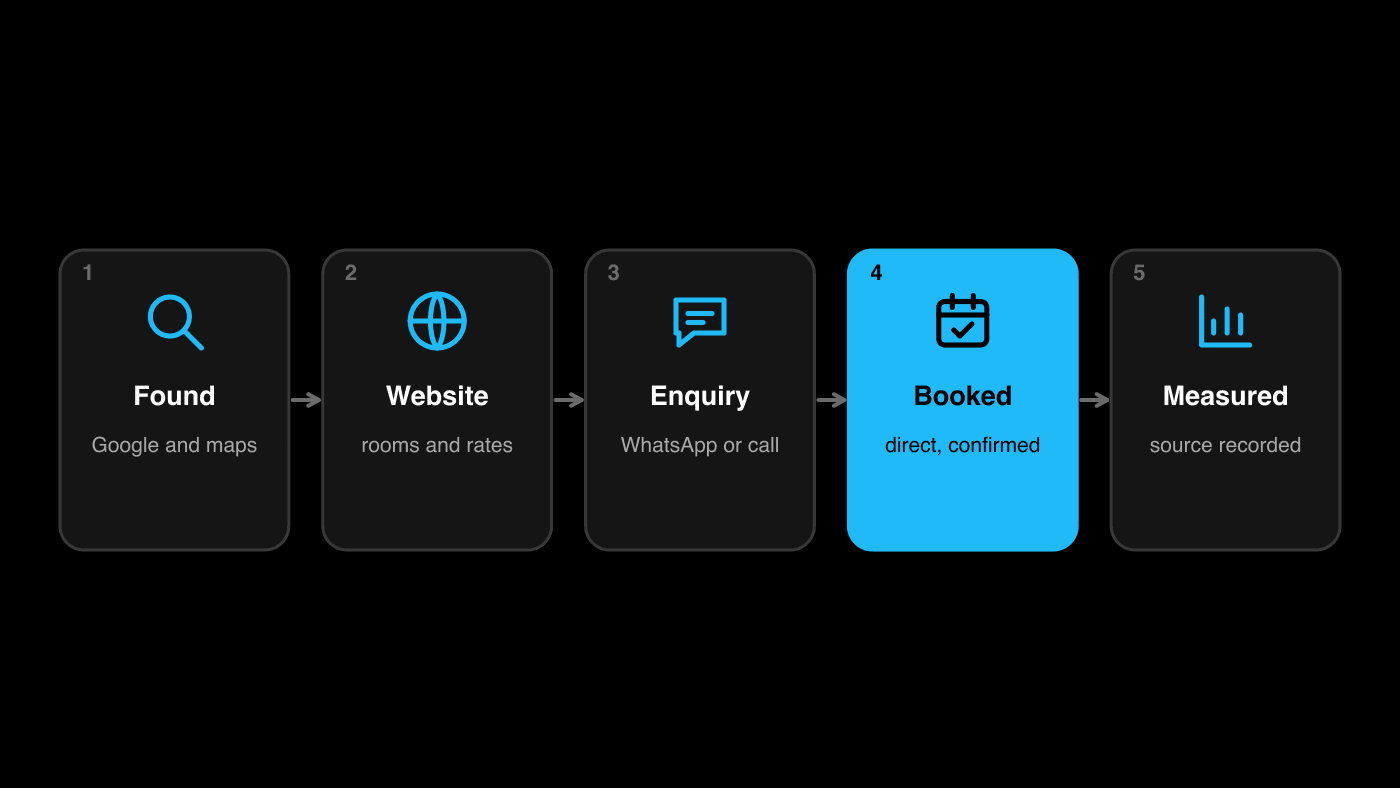
Short answer: To get more direct hotel bookings, make sure travellers can find your property on Google, trust what they see there, and book without friction on your own website or WhatsApp. Then measure where bookings come from. Direct bookings are built from a good Business Profile, a clear website and prompt replies, not from any single ad.
Online travel agencies and booking portals are good at one thing: putting a hotel in front of people who are ready to book. They are not good at making a guest yours. Every booking through a portal is a booking the portal owns first, and the hotel pays for the introduction.
Direct bookings do not mean abandoning portals. They mean building a second door, so that people who already know your name, or find you on Google, can walk through it without a middleman.
Why do travellers book through portals instead of your website?
Three reasons explain most of it, and none is about price alone.
- They find the portal first. A search for hotels in a city often shows portals and maps before individual websites.
- They trust what they can compare. Photos, reviews, cancellation terms and a familiar payment flow reduce anxiety.
- Booking is easier there. A portal's checkout is polished. Many hotel websites make a guest work to find rooms, rates and a way to pay.
To win a direct booking you have to be findable, credible and easy. Each maps to something you control.
How do guests find a hotel on Google?
Guests searching for a stay often look at maps and local results, then at a hotel's website. For most independent hotels the most important listing is the free Google Business Profile. Google says local results are mainly based on relevance, distance and prominence, and that you cannot pay for a better local ranking (see how Google ranks local results). So the job is to make your profile complete and accurate, verified, well photographed and steadily reviewed.
Check the basics: exact name, category, address, phone number, a working website link, opening details, amenities, real photographs of rooms, entrance and neighbourhood, and answers to common questions. Reply to reviews in a courteous, factual way. If the property does not appear even for its own name, start with the checks in why a local business is not showing on Google.
What makes a hotel website good at converting bookings?
A hotel site should let a guest do four things in a minute on a phone: see the rooms, understand the price basis, check whether dates are available or ask, and reach you. Look at your own site the way a stranger would.
- Rooms and photos: each room type with honest photos and a short list of what is included.
- Rates and terms: what the price covers, taxes, check-in times, cancellation and payment rules in plain language.
- Booking path: a booking engine if you have one, or a simple enquiry form and a WhatsApp button if you do not. A small property with a fast reply can outperform a clumsy engine.
- Trust: location on a map, real guest reviews you are allowed to show, and clear contact details.
- Speed and mobile use: many guests browse on phones; heavy sliders and slow pages lose them.
Read more about building pages that make one decision easy in our notes on website development.
Where should Google Ads fit?
Google Ads can put your website in front of people who are searching for stays in your area, including searches that include your hotel's name. It is worth considering when you have a working website and a way to measure bookings. Start with a small budget, include a phone call and booking-enquiry goal so results are countable, and focus on searches that show intent to stay, such as room types and locality names, rather than broad travel words.
Learn how conversion tracking works in Google's conversion tracking overview: it lets you record valuable actions such as calls and form submissions, and it is what lets ad systems learn from results. Without it, you can only count clicks.
How do social media and content help direct bookings?
Social platforms work best for hotels as proof and reminders, not as a sales counter. Short videos of rooms and mornings, local recommendations, seasonal offers and real guest moments (with permission) show what a stay is like. Each post should give a next step: a link to the website booking page, or a WhatsApp chat with dates pre-filled.
Content on your own site also helps: a guide to the neighbourhood, an explanation of what to expect at check-in, and pages for the most common questions guests ask. Write them for guests, not for search engines.
How should you handle WhatsApp and phone enquiries?
For many independent hotels and homestays, a large share of enquiries arrive by phone or message. Make that channel work:
- Show a phone number and WhatsApp button on every page and on the Business Profile.
- Use a WhatsApp Business greeting and quick replies for rates, availability and directions.
- Reply quickly. A guest choosing where to stay is comparing several options at once.
- Log every enquiry with its source and whether it became a booking.
How do you reduce dependence on portals without losing bookings?
Do it gradually. Keep portals for reach, and give returning and referred guests a reason to book direct: a small perk that costs you less than the portal fee, such as breakfast, flexible check-in or a late check-out where possible. Tell past guests how to reach you, add a direct-booking link to your confirmation messages where the portal's rules allow, and check the terms of each portal so you stay within them.
Avoid inventing statistics about how much you will save. Work out your own numbers: how many bookings came from each source last quarter, what each source cost you, and what you would earn direct.
How do you measure direct bookings?
Track by source. For each booking record how the guest found you: Google, Instagram, referral, portal, repeat. Watch calls and direction requests on your Business Profile, enquiries from the website, and bookings that followed. For ads, use conversion tracking so Google Ads counts calls and form submissions rather than clicks. A monthly table is enough: enquiries, bookings and revenue by source.
A small-hotel scenario (illustrative, not a client result)
Picture a 12-room heritage-style hotel that gets most bookings through portals. Its Google Business Profile has old photos and a wrong phone number. Its website lists rooms without prices and has no WhatsApp button. Nobody records where guests come from.
The owner updates the profile with current photographs and details, adds prices and cancellation terms to the site, puts a WhatsApp button on every page, and starts a simple sheet of sources. Nothing here is clever. But a traveller who searches, sees a credible profile, checks the site and finds a fast reply now has a reasonable direct route, and the owner can see how many use it.
Common mistakes
- Treating the website as a brochure, not a booking tool.
- Letting the Business Profile go stale.
- Hiding rates or terms.
- No mobile testing.
- Not answering messages promptly.
- Comparing direct and portal bookings by revenue alone without the fee paid.
A direct-booking checklist
- Business Profile complete, verified, current photos, correct contact details.
- Website shows rooms, honest photos, rates basis and policies.
- Booking engine or enquiry form works on a phone.
- Phone and WhatsApp visible everywhere.
- Reviews answered courteously.
- Ads, if used, track calls and enquiries as conversions.
- Every booking records its source.
- A small, real reason for repeat guests to book direct.
Questions hotels ask about direct bookings
How can a small hotel increase direct bookings?
Make the property easy to find (a complete Google Business Profile), easy to trust (honest photos, clear terms, real reviews) and easy to book (a clear booking path and quick replies). Then track the source of each booking.
Is a booking engine necessary?
Not always. A booking engine helps when you have enough volume and availability to manage. A small property with a clear website, a WhatsApp button and fast replies can take direct bookings too. What matters is that the path is easy and reliable.
Do hotels need Google Ads?
They are optional. Google Ads can help reach people searching for stays, but a hotel should first have a good profile and website. If you run ads, measure calls and enquiries so you know they work.
Can I stop using portals?
Most hotels use portals as one channel among several. A more realistic goal is to increase the share of bookings that come direct over time, while keeping portals for reach.
How long does it take to see more direct bookings?
It varies with your starting point, competition, season and effort. Improvements to a profile and website can be quick to make, while results build over time. Judge progress by monthly bookings by source.
The short version
Direct bookings come from being found on Google, trusted at a glance and easy to book. Fix your Business Profile, make the website a working booking tool, answer messages fast, use ads only when you can measure them, and record the source of every stay.
If you would like your hotel's online presence reviewed for direct bookings, talk to Advertizer. We can look at your profile, website and enquiry path together.