
How Travel Businesses Can Get Enquiries Without Depending Only on Portals
Short answer: To get travel enquiries without relying only on portals, publish pages for the destinations and packages people search for, keep your Google Business Profile accurate, share proof from real trips, make WhatsApp and phone enquiry effortless, and track which channels produce paid bookings. Portals stay useful as one channel; your own pages and profile become the channel you control.
A portal gives a travel business visibility and takes a share of the relationship. The traveller is the portal's customer first. Nothing is wrong with that trade when it works, but a business that has only portals has no way to reach the same person again, and no control when fees or rules change.
The goal is not to abandon portals. It is to build an enquiry channel that belongs to you.
Why do travel businesses depend so much on portals?
Three reasons keep coming up. Portals show up first in many searches. They provide comparison and trust in one place. And building your own presence feels slow, so it is postponed.
Each has an answer. Your own pages can be found for the searches that matter to you. Trust can be built with real proof. And a small set of good pages and profiles is not as slow to build as it appears.
What are travellers searching for?
Travel searches move through stages. A useful map:
| Stage | Search pattern | What the traveller needs |
|---|---|---|
| Dreaming | places to visit, itinerary ideas | Inspiration and confidence |
| Planning | destination + days, best time to visit | A practical plan |
| Choosing | package, tour operator, taxi, hotel + place | Options and prices |
| Ready | operator near me, contact, booking | A quick, trustworthy way to enquire |
A travel business can serve all four, but the last two are where enquiries come from, so start there. Build pages for the packages and services you truly sell.
What should a package or destination page contain?
A page that helps a traveller decide is more than a price. Include:
- What the trip is and who it suits: family, pilgrimage, solo, group
- A day-by-day outline in plain language
- What is included and not included
- Transport, stay and meal details
- Season, weather and practical advice
- Cancellation and payment terms
- Photos from real trips, with permission where people are visible
- A clear way to enquire: phone, WhatsApp and a short form asking dates and group size
Do not copy text from other operators or portals. Write from experience: what you actually arrange, what travellers ask, what goes wrong and how you handle it. That is what other pages lack.
How can local presence bring travel enquiries?
If you have an office and take walk-ins or local calls, your Google Business Profile matters. Google's help page on local ranking explains how profiles are matched to searches. Complete every section, keep hours and contact details accurate, use real photographs, and encourage genuine reviews from travellers after a trip. When a profile does not appear, why a local business is not showing on Google is the place to start.
Where does destination content help?
For a destination such as Varanasi, travellers ask about practical things: how many days to plan, where to stay, what to see, how to get around, and what the local customs are. A guide that answers these questions honestly earns attention and trust. It also gives you a natural place to introduce your services, for example by linking a guide about a city to the tours you run. Use only facts you can support, and avoid invented visitor numbers or claims of being the only or best operator.
How do social media and video help?
Travel is visual. Short videos from real trips, traveller stories with permission, and answers to common questions create familiarity. Use them to lead to a next step: a package page, a WhatsApp chat or a call. Keep a consistent presence, and use highlights to organise itineraries, safety information, testimonials and how to book.
Where do Meta Ads and Google Ads fit?
- Google Ads can capture people searching for a specific package or operator. Focus on searches that show intent to book, and send each to the matching page.
- Meta Ads reach people who are not searching yet and suit seasonal campaigns, new packages and remarketing to people who visited your pages.
Both need conversion tracking so you can count enquiries, calls and bookings, not only clicks. See Google's conversion tracking overview for how actions are recorded, and read about our performance marketing.
How should you handle WhatsApp and phone enquiries?
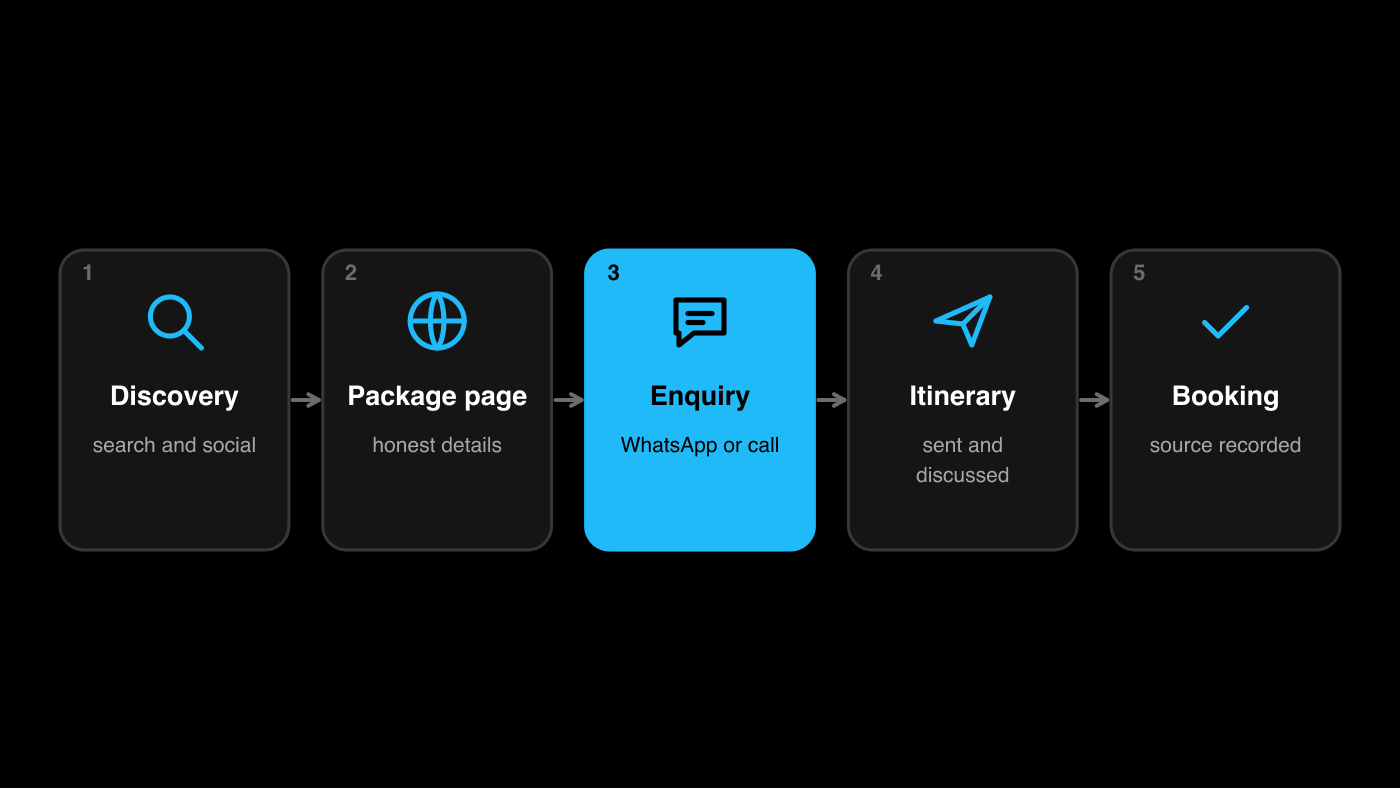
Travellers usually want a quick conversation. Set up WhatsApp Business with a greeting message, a catalogue of packages, and quick replies for common questions. Ask for the essentials early: travel dates, group size, budget range and starting city. Send a clear written summary of what you discussed, and follow up on a schedule. Keep a log so you can see which sources produce bookings.
How do you know which channel is working?
Record the source of every enquiry and follow it to a booking. A simple table with enquiries, quotations, bookings and revenue by source is enough. Compare portals with direct channels by what each cost you and what you earned, including portal fees. Do not rely on generalised figures from articles; use your own.
How do you present prices and itineraries honestly?
Travellers compare your quote with a portal's, so clarity is your advantage. A few habits protect trust:
- Say what the price covers, and what it does not: entry tickets, meals, taxes, guide fees, transport between cities, tips.
- Explain seasonal differences instead of hiding them. A price that changes at festival time is normal; a surprise is not.
- Show the cancellation and payment terms before the traveller asks.
- Avoid a very low headline price that only applies to a set of conditions most travellers will not meet.
- When a traveller says a portal is cheaper, ask for the itinerary they are comparing and check what is different: hotel category, timing, inclusions. Then explain the difference plainly, or adjust your offer.
Trips go wrong sometimes. A page that explains how you handle delays, changes and refunds tells a cautious traveller more than a slogan does.
A tour-operator scenario (illustrative, not a client result)
Imagine a small tour operator whose enquiries come almost entirely from a portal. It creates pages for its three main packages with day-by-day itineraries, inclusions and terms, updates its Business Profile, and adds a WhatsApp greeting and quick replies. It posts short videos from recent trips, and runs a small search campaign for one package with calls and forms tracked.
After a season, it can see that some enquiries come from Google and Instagram, which packages are asked about, and which channel produces paid bookings. It is no longer guessing.
Common mistakes
- Copying package descriptions from other sites.
- Hiding what is not included.
- No WhatsApp or phone option on package pages.
- Untracked enquiries.
- Ignoring reviews and messages.
- Making claims about being the best or only operator.
A checklist for travel enquiries beyond portals
- Package and destination pages exist for what I actually sell.
- Each page has inclusions, exclusions, terms and a clear way to enquire.
- My Google Business Profile is complete and current.
- I share real photos and stories, with permission.
- WhatsApp greeting and quick replies are set up.
- Ads, if used, track calls and enquiries as conversions.
- I record the source of every enquiry and booking.
Questions travel businesses ask about direct enquiries
How can a travel agency get leads without depending on portals?
Build pages for the packages you sell, keep your Google Business Profile complete, share real trip content, make WhatsApp and phone enquiry easy, and track which channels produce bookings. Portals can remain one channel.
Is SEO worth it for a travel agency?
It can be, because travellers search before booking. It builds gradually, so start with the pages and profile that matter most, and treat it as a long-term asset rather than a quick fix.
Should a travel business use Meta Ads or Google Ads?
Google Ads reach people searching for a package or operator; Meta reaches people who may become interested. Many businesses begin with what they can measure best and add the other.
How do I stop losing enquiries on WhatsApp?
Use a greeting message, quick replies and a log. Reply promptly, confirm details in writing and follow up on a schedule.
Can I use portal photos and descriptions on my own site?
Only if you have the rights. Original photos and descriptions are safer, and they tell travellers what your service is actually like.
The short version
A travel business that owns its enquiry channel has pages people can find, a profile people can trust and an easy way to talk. Build those, share real proof and track sources. Use portals for reach, but do not let them be the only door.
If you want help building direct enquiry channels for your travel business, talk to Advertizer. We can review your pages, profile, ads and enquiry handling together.