
How Manufacturers Can Generate B2B Leads With Google Ads

Short answer: Manufacturers get B2B leads from Google Ads by matching how buyers search (product, specification, quantity, location), excluding searches from job seekers, students and price-only shoppers with negative keywords, sending each product to its own page, asking for the details you need to quote, and tracking calls and forms as conversions. Measure qualified enquiries, not clicks.
A buyer looking for a component, machine or material does not browse. They search with a need in mind, often with a specification, and then compare a few suppliers quickly. That is why search advertising suits manufacturers: the person is already looking. It is also why sloppy campaigns waste money, because the same words attract people who are not buyers.
What do industrial buyers actually search for?
Buyers use product words, a material or specification, an application, and often a place. They also search for a supplier's name once they have heard of it. Group what you see into intent tiers.
| Tier | Example pattern | What the person wants | How to treat it |
|---|---|---|---|
| Ready to buy | product + supplier or manufacturer + city | A quote, a call | Highest priority, direct enquiry page |
| Comparing | product + specification or grade | Technical details | Product page with specs and a way to ask |
| Learning | how does X work, what is Y | Information | Usually not worth paid clicks; serve with content |
| Not a buyer | jobs, course, free, DIY, PDF | Something else | Exclude |
Your first list of keywords should come from your own enquiry history and sales team, not a tool: what did customers say when they first called?
How should you structure a manufacturer's campaigns?
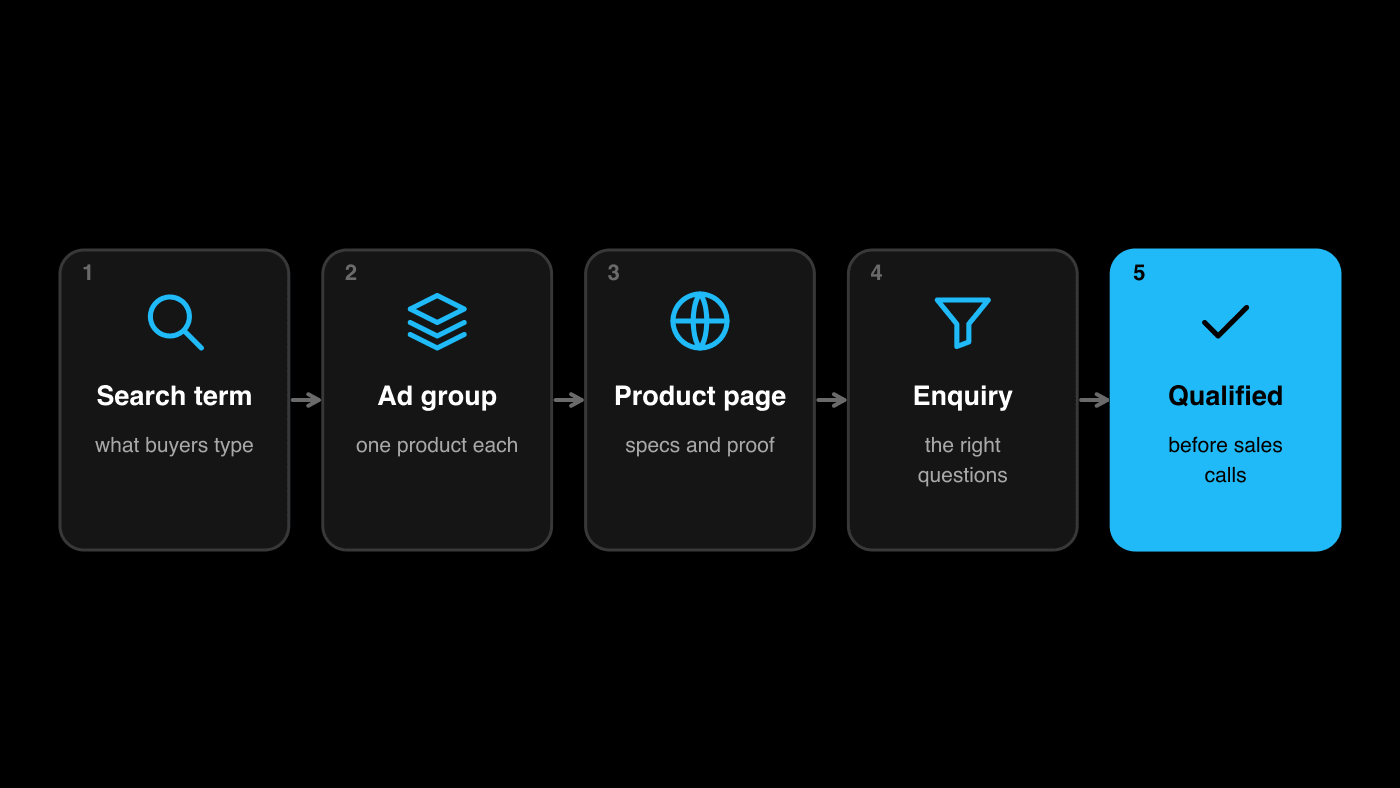
Structure follows how you sell. Use one campaign area per product line or capability, and inside it, ad groups for closely related search themes. That lets the ad and the landing page speak to a single need. A campaign that mixes unrelated products in one ad group forces generic ads and generic pages, and both perform worse.
Include location deliberately. If you supply nationally, say so; if you only deliver within regions, target them and say so on the page, to avoid enquiries you cannot serve.
How do negative keywords protect your budget?
Negative keywords let you exclude search terms so your ads do not show for them. Google's own documentation explains how they work: they can be broad, phrase or exact match, and importantly, negative keywords do not match close variants or other expansions, so you may need to add variations yourself. You can read the details in Google's negative keywords guide.
Start with a list of the searches that bring wrong clicks: jobs, careers, salary, courses, training, free, DIY, PDF, meaning, definitions, and terms for products you do not make. Review the actual search terms report regularly and add new negatives as you see them. This is routine maintenance, not a one-time task, and it is one of the most reliable ways to improve lead quality.
What should a product landing page contain?
A B2B buyer wants to decide quickly whether you can supply what they need. Build one page per main product or family, with:
- Product name and what it is used for
- Key specifications, grades or ranges, in a scannable form
- Capabilities that are true and can be verified: capacity, materials, processes, certifications you actually hold
- Photos of the product and the facility, with real images
- Delivery regions and typical lead times, if you are willing to share
- Clear enquiry options: a phone number, a WhatsApp chat and a short form
- Trust signals such as customers you have permission to name, only if genuine
Avoid generic homepage traffic. A person searching for one product should not land on a page about everything you do. Our note on why your website gets traffic but no demo requests explains why message match matters.
What should the enquiry form ask?
The form is where you collect what your sales team needs to quote, and where you filter. A workable set:
- Name, company and phone number
- Product or specification required
- Quantity or expected volume
- Delivery location
- When they need it
Every extra field lowers the number of submissions and raises their quality; find a balance by testing. Add a phone number and WhatsApp option beside the form, because many buyers prefer to call, and B2B enquiries often come by phone.
Which conversions should you track?
If the platform cannot see the actions that matter, it cannot learn from them, and neither can you. Google explains that conversion tracking lets you record valuable actions such as purchases, sign-ups and phone calls, and use that data to see which keywords and ads produce them and to support automated bidding: see Google's conversion tracking overview.
For a manufacturer, that usually means tracking form submissions, calls from ads, calls from the website's phone number, and clicks on the WhatsApp button. Then extend your own records beyond the platform: mark which enquiries became quotations and which became orders.
Advertizer's Shyam Steel Industries case study illustrates why this matters. It describes testing WhatsApp, lead-form and call campaigns, with data identifying direct calls as the highest-intent channel. The lesson is not that calls always win; it is that you need to measure each route to know.
How do you qualify enquiries before your sales team wastes time?
A short internal script helps. When a lead arrives, someone should confirm what the buyer needs, the quantity, the location and the timeline, and record it. Decide upfront what makes a lead a good fit, for example a minimum quantity, a supported location or a product you make. Mark the rest as not suitable, with a reason. Over time that record shows which keywords bring buyers and which bring noise.
How should you use bidding and budget?
Begin with a controlled test: a small set of strong keywords, tight negatives, and manual or simple bidding until you have a few real conversions to learn from. Automated bidding strategies depend on conversion data and need time to learn after each change, so avoid changing everything at once. Increase the budget when you see qualified enquiries at a cost that makes sense for your order values. Our guide on how to set a marketing budget covers how to work that out.
A sample account restructure (illustrative, not a client result)
Imagine a manufacturer of industrial components running one broad campaign for "industrial parts". Clicks are plentiful, and many are from students and job seekers. The team splits campaigns by product family, adds negatives for jobs, courses and free downloads, writes ads that state material and application, and sends each family to a page with a specification table and a short form asking for quantity and location. Calls from the ad and website are tracked.
Within a few weeks the search terms report shows which terms bring quotation requests. The team keeps those, adds negatives for the rest and pauses ad groups that never produce a quote. The improvement is a steadier stream of relevant enquiries and a clearer picture of what to pay for.
Common mistakes
- One campaign, one page, every product.
- No negative keywords, or never reviewing search terms.
- Tracking form fills but not calls or WhatsApp.
- Counting all enquiries as leads.
- Overstating capacity, certifications or delivery on the page.
- Judging the campaign in a week.
A manufacturer's Google Ads checklist
- Keywords come from real buyer language and enquiry history.
- Campaigns and pages are organised by product family.
- Negative keywords cover jobs, courses, free, DIY and unrelated products.
- The search terms report is reviewed on a schedule.
- Each landing page shows specs, capabilities and an easy way to enquire.
- The form asks for product, quantity, location and timeline.
- Calls, forms and WhatsApp clicks are tracked as conversions.
- Enquiries are marked as suitable or not, and followed through to quotation and order.
Questions manufacturers ask about Google Ads
Does Google Ads work for manufacturers?
It can, because buyers search when they have a need. Results depend on keyword choice, negative keywords, landing pages, response speed and tracking. Poorly structured campaigns waste money on the wrong searches.
What are negative keywords, and why do they matter in B2B?
They are terms you exclude so ads do not show for them. In B2B they filter out jobs, courses, free-download seekers and unrelated products. They do not automatically cover close variants, so you must review search terms and add variations.
How do I track phone calls from Google Ads?
Google Ads supports call-related conversions. Use call assets and website call tracking where available, and record calls in your own log too, so you can connect calls to quotations and orders.
Should manufacturers use Meta Ads too?
Meta can help with awareness, brand recall and retargeting, but B2B buying searches happen on Google. Many manufacturers start with search ads and consider others once tracking works.
What budget do I need?
It depends on how many searches exist for your products, the value of an order and how many enquiries become sales. Work backwards from those numbers and test a small budget before scaling.
The short version
For manufacturers, Google Ads is a way to be present when a buyer searches with a specification in mind. Match their words, keep the wrong searches out, give each product its own page, ask the questions you need to quote, and track calls and forms all the way to orders.
If you would like your industrial campaigns and landing pages reviewed, talk to Advertizer. We can look at keywords, negatives, pages and tracking together.