
Why Coaching Ads Bring Enquiries but Not Admissions
Short answer: When coaching ads bring enquiries but not admissions, the ad is usually not the weak link. Look at who is enquiring (students, parents or browsers), how quickly and how well you respond, what happens in the counselling call, and whether every enquiry is tracked to a demo class and a seat.
Your ads are working, in the sense that the phone and the enquiry sheet are busy. Yet at the end of the month the seat count has barely moved. That is one of the most common frustrations in coaching marketing, and it is fixable, because it means the top of your funnel is doing its job.
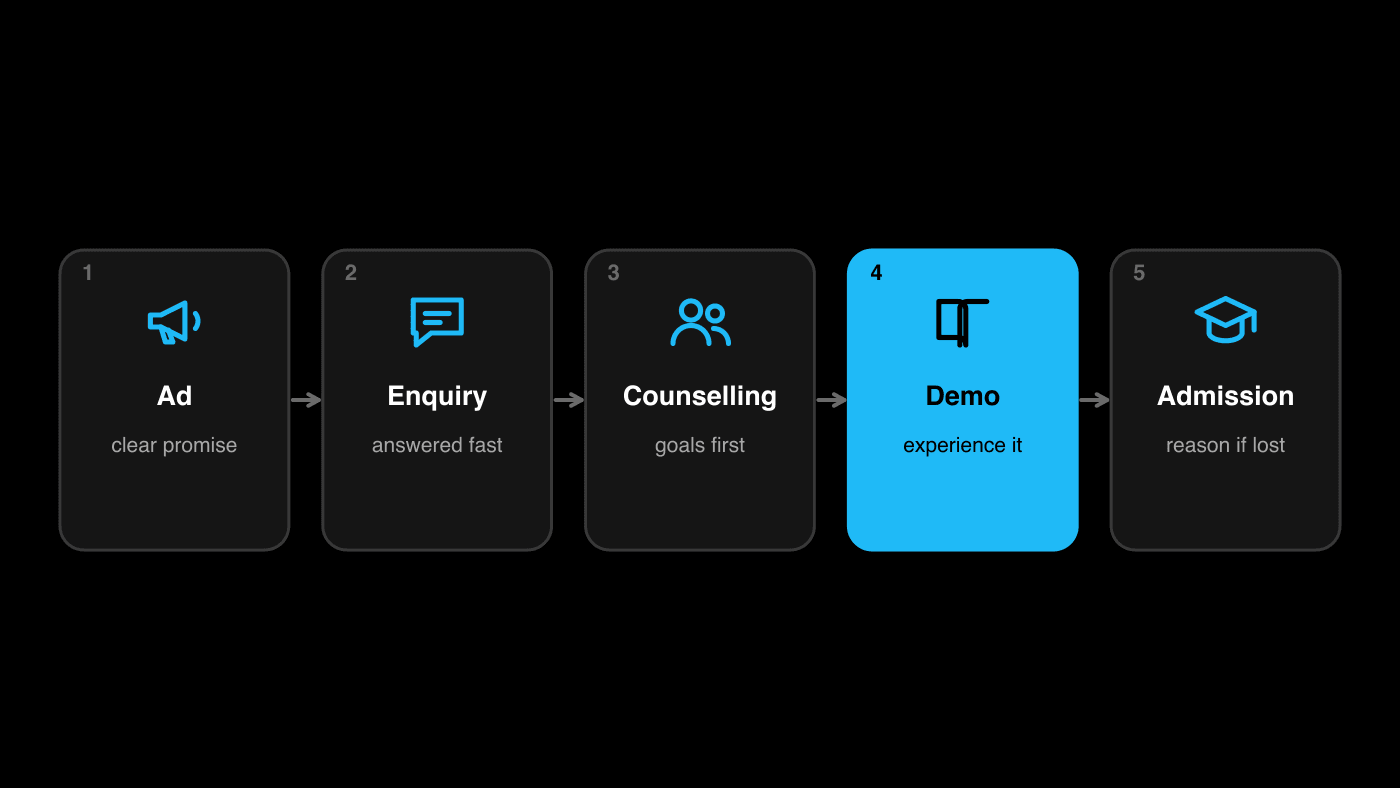
An admission is the last step of a chain: ad, enquiry, conversation, demo, decision, fee, seat. Marketing gets attention for the first two steps. The other five are operations.
Which enquiries are really admissions waiting to happen?
Not every enquiry is a prospective student. Sort last month's enquiries into four groups:
- Ready: the right class, the right time, able to afford it.
- Interested but undecided: need answers, a demo or a family conversation.
- Browsers: curious, comparing, or asking about something you do not offer.
- Unreachable: wrong or unanswered numbers.
If browsers and unreachable numbers are most of your list, the problem starts at the ad and the form. If most are ready or undecided and still do not join, the problem is after the enquiry. Knowing which of the two you have saves months of guessing.
Why do coaching enquiries not become admissions?
Six reasons cover most cases.
- The ad promises more than it explains. Results-flavoured creative attracts people who have not read the batch details, fees or eligibility.
- The decision-maker is missing. For school-age students, parents decide; for competitive-exam aspirants, the student and family both matter. Talking to only one loses the sale.
- Response is slow. Interest is highest at the moment of enquiry.
- The counselling call is a sales pitch, not a conversation. Good counselling asks about goals and gaps first.
- There is no bridge to experience. People join what they have felt: a demo class, a test, a campus visit.
- There is no follow-up plan. Many undecided families need more than one contact before they decide, and follow-up often stops after the first call.
Who is your ad talking to: the student, the parent, or both?
Write two versions of your message. The student wants to know what they will learn, how they will be taught and whether they can keep up. The parent wants to know safety, discipline, faculty, schedule, fee and outcomes. An ad that speaks only to one leaves the other unconvinced.
The simplest fix is to put both answers on the landing page: a short section for students and a short section for parents, plus a clear way to book a counselling slot. Show real faculty names and qualifications, real batch timings and the fee structure you are willing to share, so families do not have to ask.
What should a coaching landing page contain?
A landing page should answer the questions a family would otherwise phone to ask. A useful outline:
- Which courses and classes it is for, and who should not apply
- Batch timings and duration
- Faculty, with real names and backgrounds
- Fee structure or how to get it
- The way you assess and support students
- A demo class or counselling booking with one obvious action
- Address, map and phone, with a WhatsApp option
The page you use for ads should be about one course and one action. If your website is a general brochure, an ad-specific page will often perform better. Our guide to website development explains how pages are structured to make one decision easy.
How fast and how well should you respond?
Reply quickly, and reply as a person. A practical routine:
- Send an immediate acknowledgement by WhatsApp with the course name and what happens next.
- Call within the same working session, and again at a different time if unanswered.
- Begin with questions: current class, target exam, goals, and what has not worked so far.
- Offer a demo class or test as the next step, not the fee.
- Send the details you discussed in writing, then schedule the next follow-up.
Assign every enquiry to a named counsellor. If several people can pick up an enquiry, sometimes nobody does.
What should follow-up look like for undecided families?
Many decisions involve consultation at home, comparison with other institutes, and timing around school exams. So the follow-up plan should be a short sequence, not a single call. For example: a follow-up after the demo class, a message with a relevant success story or study plan, an invitation to a parent session, and a final reminder before batch closing. Keep each message useful, and stop when someone says no.
Do not invent urgency. If seats are genuinely limited, say how many and why. If they are not, do not pretend.
How do you track an enquiry to an admission?
Keep one sheet or CRM with these columns: date, source (which ad, page or referral), name, student or parent, course, counsellor, stage, next action and date, and outcome with reason. The stages might be: enquiry, reached, counselled, demo attended, fee discussed, admitted, lost.
From that sheet you can see the numbers that matter: what share of enquiries were reached, what share attended a demo, what share joined, and which sources produced admissions rather than only enquiries. Then compare campaigns by cost per admission, or at least cost per demo attendance. Optimising for cost per enquiry rewards the wrong behaviour.
Where do Meta Ads and Google Ads fit?
Search intent on Google, for example someone searching for a course in a city, reaches people already looking. Meta's platforms reach parents and students who were not searching, which suits new batches, results announcements and events. Whichever you choose, send the traffic to a focused page, and keep the lead form short, with one question that helps you sort the enquiry, such as course or class. See our Meta Ads services for how campaigns are built and measured.
An illustrative scenario (illustrative, not a client result)
Suppose a coaching centre runs ads for a new batch and gets many enquiries. On review, half the numbers never answer, replies to the rest take a day, and counselling calls go straight to the fee. The centre changes four things: a shorter form with a course question, an immediate WhatsApp acknowledgement, a counselling script that starts with goals, and a free demo class before any fee discussion. It starts a sheet that records stage and reason.
The enquiry count may fall slightly. The share of enquiries that reach a demo class and then a decision typically rises, because the process now creates the conditions for a decision. Judge it by demos attended and admissions, not by forms received.
Common mistakes
- Celebrating enquiry volume.
- Treating the parent as an afterthought, or the student as one.
- Quoting the fee before understanding the student.
- Leaving enquiries unassigned.
- Giving up after one follow-up.
- Advertising results you cannot document or that are not your own.
An admission-funnel checklist
- Enquiries are sorted into ready, undecided, browsers and unreachable.
- The ad and page speak to both students and parents.
- The landing page shows faculty, timings, fee route and one action.
- Every enquiry gets an acknowledgement and a call within the same session.
- Counselling starts with questions and offers a demo first.
- Undecided families receive a planned, useful follow-up sequence.
- A sheet records stage, next action and reason for loss.
- Campaigns are compared by demos and admissions.
Questions coaching institutes ask about leads
Why do coaching leads not convert into admissions?
Common reasons are low-quality enquiries, slow or generic follow-up, a missing decision-maker (often the parent), no demo experience, and no tracking after the enquiry. Sorting enquiries by type shows which reason applies to you.
How can I get better admission leads for my coaching institute?
Be specific in the ad about the course and who it is for, use a short qualifying form, and send people to a focused page with real information. Improve the response and counselling process at the same time, or better leads will still leak away.
Are Meta Ads or Google Ads better for coaching institutes?
They reach different moments. Google captures people searching for a course; Meta helps you reach students and parents who were not searching, for example for new batches. Many institutes use both and compare cost per admission.
How many follow-ups are enough?
There is no fixed number. Follow up as long as the person is undecided and it stays useful, and stop when they decline. A planned sequence is better than repeated identical calls.
Should I share the fee upfront?
Being open about the fee route avoids wasted calls, but the fee is easier to discuss after the family understands the course and has seen a demo. Decide a policy and apply it consistently.
The short version
If enquiries are not becoming admissions, the fix is usually in the steps after the ad. Know who is enquiring, speak to the parent and the student, respond fast and like a counsellor, let people experience a demo before deciding, follow up in a planned way, and track every enquiry to its outcome.
If you want your admission funnel reviewed from ad to seat, talk to Advertizer. We can look at the ads, the landing page and the follow-up process together.