
How to Generate Preschool Admission Enquiries Online
Short answer: Preschool admissions come from parents who can find the school, trust it and visit easily. Complete your Google Business Profile, answer the questions parents actually ask, show the school and staff honestly, make enquiring a one-tap action, and turn every enquiry into a campus visit. Protect children's privacy in everything you publish.
A parent choosing a preschool is making one of the first big decisions for their child. They search near home, ask other parents, compare two or three places and decide largely on trust. Your marketing has to do the work a friendly neighbour would: reassure, explain and invite.
What do parents look for before they call?
Parents' questions are quite consistent. Write yours down after listening to what your front desk hears:
- Is it safe, clean and well supervised?
- Who are the teachers, and how are they trained?
- What will my child do all day, and how will you handle the first weeks?
- What are the timings, the age groups and the fees?
- How far is it, and is there transport?
- What do other parents say?
Marketing that answers these earns enquiries. Marketing that shows only smiling children and a slogan does not.
Can parents find your preschool?
Most parents begin with a search for a preschool near them. That search depends on your Google Business Profile: accurate name, address, phone number, hours, photos, and real reviews. Google names three signals behind local results, relevance, distance and prominence, and says rankings cannot be bought; its help page explains each. So make your profile complete, verified and current. A school that is missing from nearby searches can work through why a local business is not showing on Google.
Add a simple, fast website with the same details. It should load quickly on a phone and lead with what parents need.
What should the school website say?
Make a single page answer the questions above. A useful structure:
- Who we are: the school's approach in plain words, and the age groups you serve
- A day at school: a realistic schedule and the environment
- Teachers and safety: staff, qualifications you can verify, safety practices, transport arrangements
- Admissions: how to enrol, timings, and what to bring to a visit
- Fees: the structure, or how to get it
- Contact: phone, WhatsApp, map and an enquiry form
Real photographs and short videos of the actual premises are worth more than generic images. Keep claims factual. If you have an affiliation, accreditation or award, state it accurately and only if it is real.
How do you protect children's privacy in your content?
Photos and videos of children make marketing warm, and they carry responsibility. Get written consent from parents before you publish an image or video of a child, explain where it will be used, and honour requests to remove it. Avoid showing full names, addresses, uniforms with school names in unsafe contexts, or details that could identify a child's routine. Keep the school's data-protection practices in line with applicable Indian law and platform rules, and take advice if you are unsure.
This is not only compliance. Parents notice how a school treats other children's privacy, and it affects trust.
What content works for preschools?
Content that reassures and informs:
- Short videos where the principal or a teacher answers a common parent question
- A walk through the classroom, play area and safety features
- A normal day, shown honestly
- Parent-friendly explanations of learning through play and how you support each child
- Events and activities, with consent for any child shown
- Testimonials from parents who have agreed to share them
Advertizer's case studies show two approaches. The Kidzee Ramnagar case study describes replacing costly offline campaigns with hyperlocal digital work using local creators, Meta ads and community storytelling. The My Nurture Preschool case study describes cinematic videos of the environment, teachers and student experience amplified through hyperlocal Meta advertising. Read them for what was done and how the clients describe the outcomes.
How should a preschool use Meta Ads?
Meta ads work well for a local, considered decision like this, when you use them precisely.
- Audience: the neighbourhoods within a realistic travel distance, and parents of the relevant age group where the platform allows it.
- Message: one concrete invitation, such as an open day, a campus tour or a summer programme.
- Creative: a real video of the school, with a teacher speaking to parents.
- Destination: a page or chat that offers a visit or a call back, not a general home page.
- Timing: admission seasons, and the weeks parents actively compare.
Also review the platform's advertising policies before publishing any ad involving children. Our Meta Ads services explain how campaigns are built and measured.
How do you turn enquiries into campus visits?
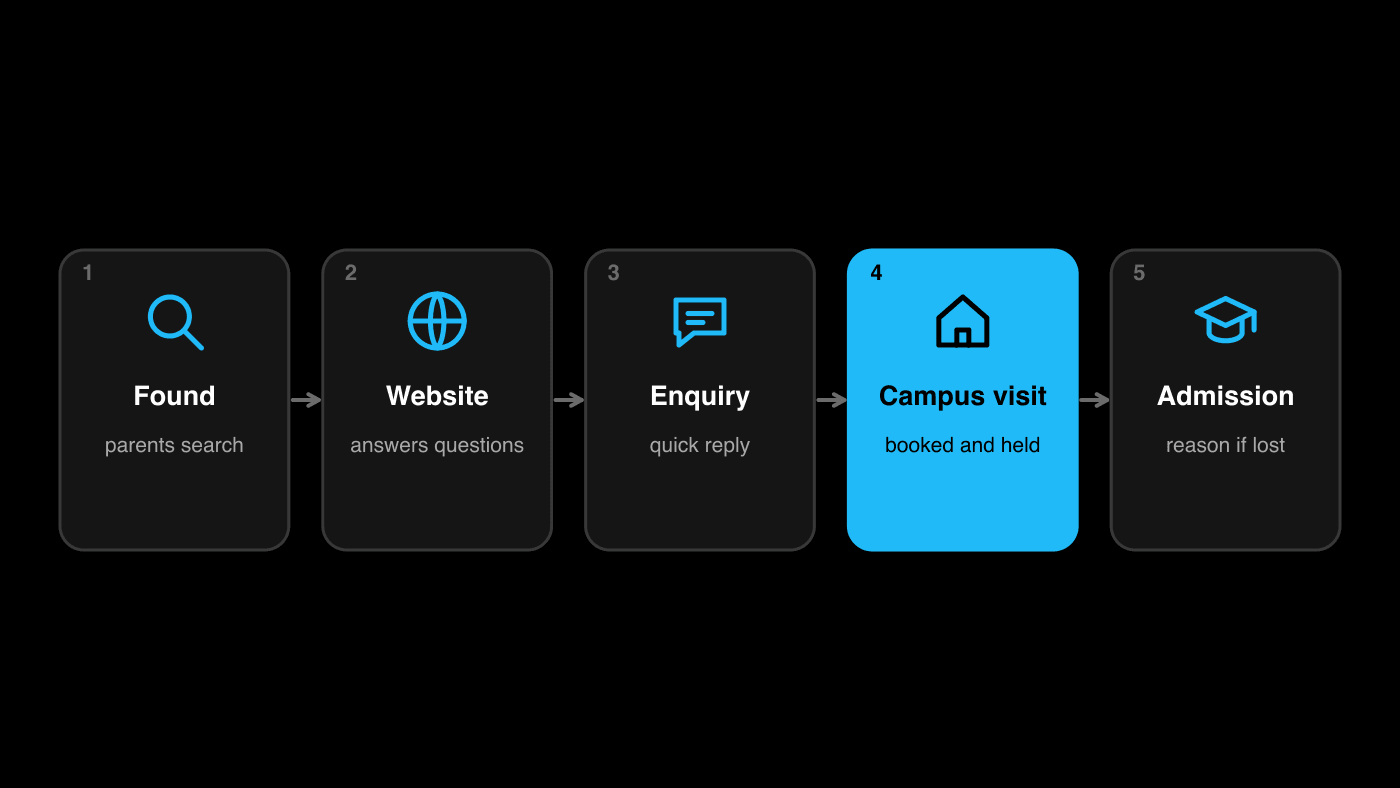
An enquiry is not an admission. The most important step is a visit, because parents decide when they see the place and meet the teachers.
- Reply to every enquiry quickly, by the channel the parent used, with a warm, personal message.
- Ask two simple questions: the child's age and the parent's preferred visit time.
- Offer a specific visit slot, and confirm it in writing.
- Prepare the visit: who welcomes them, what they see, who answers questions.
- Follow up after the visit with a short message and the next step.
- Record the outcome and the reason for any decision not to join.
How should you use WhatsApp?
WhatsApp is often the channel parents prefer. Use WhatsApp Business with a greeting message, quick answers for timings and fees, and clear opt-in for updates. Send messages only to people who have agreed to receive them, and keep them relevant.
How do you measure admissions?
Track a simple funnel: enquiries, replies, visits booked, visits done, admissions. Record the source of each enquiry: Google search, Instagram, an ad, a referral. Then compare sources by visits and admissions rather than by enquiries. Word of mouth from existing parents is usually valuable: ask happy parents for a review and a referral at a natural moment.
What does an admission-season calendar look like?
Parents begin comparing schools weeks before a session starts, so marketing that starts at the last minute meets people who have already decided. Plan backwards from your admission window, in weeks rather than fixed dates, because seasons differ by school and area.
| When | Focus | What to have ready |
|---|---|---|
| Well before the window | Foundations | Verified Google profile, current photos, the parent FAQ page, consent forms for children's images |
| Early in the window | Visibility | Videos answering parents' questions, a local ad inviting visits, a WhatsApp greeting |
| Middle of the window | Conversion | Open day or campus tour slots, quick replies, visit reminders |
| End of the window | Decisions | Follow-ups after visits, a clear next step, an honest note on seat availability |
| After the window | Learning | Which sources gave visits and admissions, and what parents asked most |
Review the calendar after each session and move the pieces that worked earlier next time.
A preschool scenario (illustrative, not a client result)
Suppose a preschool has a lovely Instagram page and few admissions. Its Google profile has outdated photos, its website has no fee route, and enquiries wait until the office reopens. The school updates the profile, adds a parent FAQ page, replies to messages within the hour with a visit offer, and runs a small local ad for an open day with a video of the principal explaining the school's approach.
Enquiries do not multiply overnight, but the ones that arrive now have answers, a visit slot and a person waiting for them.
Common mistakes
- Beautiful posts with no information parents need.
- Publishing images of children without proper consent.
- Leaving the Google profile unverified or outdated.
- A single generic message for every parent.
- Skipping the campus visit step.
- Quoting results or accreditation that cannot be proved.
A preschool admissions checklist
- Google Business Profile is complete, verified and has current photos.
- The website answers parents' key questions on one page.
- Written parental consent exists for every child shown.
- Every enquiry is answered quickly, with a visit slot offered.
- The visit is planned, and there is a follow-up message.
- Ads, if used, are local and invite a visit.
- Sources and outcomes of enquiries are recorded.
Questions preschool owners ask about admissions
How can a preschool get more admission enquiries online?
Be easy to find (a complete Google Business Profile), easy to trust (a clear website, real photos, honest information) and easy to contact (phone, WhatsApp, a short form). Then convert enquiries into campus visits, where most decisions are made.
Are Meta Ads useful for preschool admissions?
They can be, because parents in a neighbourhood can be reached with a specific invitation such as an open day. They work best alongside a good Google profile and a fast, friendly reply process.
Can I post photos and videos of children?
Only with clear written consent from parents, and with care about what details are visible. Follow applicable law and platform rules, and remove content when a parent asks.
How important are reviews?
Reviews help parents feel confident and can support your local visibility, but they must be genuine. Ask satisfied parents at a natural moment and reply courteously to every review.
When should admissions marketing start?
Parents compare schools before the admission season, so start early enough for them to find you, visit and decide. Plan content and ads around your local admission calendar.
The short version
Preschool admissions follow trust. Help parents find you, answer their questions, respect children's privacy, make it easy to ask, and invite every enquirer to visit. Measure by visits and admissions, not by likes.
If you want your preschool's online presence and admissions path reviewed, talk to Advertizer. We can look at your profile, website, content and follow-up together.