
How Interior Designers Can Get High-Intent Leads Online
Short answer: Interior design leads come from three things working together: a portfolio that shows real projects and how you solved problems, visibility at the moments people search or browse (Google for intent, Instagram for taste), and a simple first conversation that qualifies budget, scope and timeline without scaring people away. Measure enquiries that became consultations and projects, not just messages.
People hire an interior designer for a home or space that matters to them, often with a significant budget and emotional weight. They rarely decide from an advertisement alone. They decide after seeing whether your work looks like the life they want, and whether you seem easy to work with.
What makes a lead "high intent" for a designer?
Not every enquiry is worth a consultation. A high-intent lead usually has a real project, a location you serve, a budget range that suits your work and a rough timeline. Compare that with the enquiry that says "how much per square foot?" and disappears. Decide what a good enquiry looks like for your studio, and design your marketing to attract it and filter the rest.
Why do designers get admiring followers and few clients?
- The portfolio shows photographs, not decisions. Viewers see finished rooms but not the brief, the constraints or the outcome.
- Nothing is location-specific. People searching for a designer in a city cannot tell you work there.
- Price questions are unanswered. Serious clients hesitate to ask, and casual ones ask too early.
- No obvious next step. Beautiful pages end without an invitation.
- Slow first response. People planning a project talk to several designers at once.
How should you present a portfolio so it produces enquiries?
Treat each project as a short story, not a gallery:
- The brief: who the client was, what they wanted and what constrained the project (space, budget range, family needs).
- The approach: two or three decisions and why you made them.
- The result: clear photographs, including details, with credit where others contributed.
- The scope: what you handled and what was left to others.
- A next step: a button to discuss a similar project.
Only publish projects you have the right to show, with client consent, and label imagery honestly: distinguish renders from photographs. Avoid stock images of interiors presented as your work.
How do you attract clients who are searching on Google?
Someone typing a designer's service plus their city is looking to hire. Google Ads and a strong Google Business Profile serve those moments. Build service pages for what you do, such as residential interiors, modular kitchens or commercial spaces, and make each specific to your location and approach.
If you run Google Ads, focus on searches that show intent, add negative keywords to exclude jobs, courses and DIY searches, and send each ad to the page that matches. Track calls and form submissions as conversions; Google explains how in its conversion tracking overview. For local visibility, see why a local business is not showing on Google.
How does Instagram fit?
Instagram suits design because people browse it for taste. Use it to attract people who are not searching yet, and to reassure those who have already found you.
- Post project stories: before, process, after.
- Share short videos explaining decisions: why this layout, why this material.
- Use highlights for services, process, testimonials and how to enquire.
- Add location to your profile and posts.
- Link to a consultation booking or WhatsApp chat.
Instagram's audience is broad, so use ads sparingly and locally, promoting content that already earns interest. See our social media management work for how content and profiles are organised.
How do you qualify enquiries without discouraging good clients?
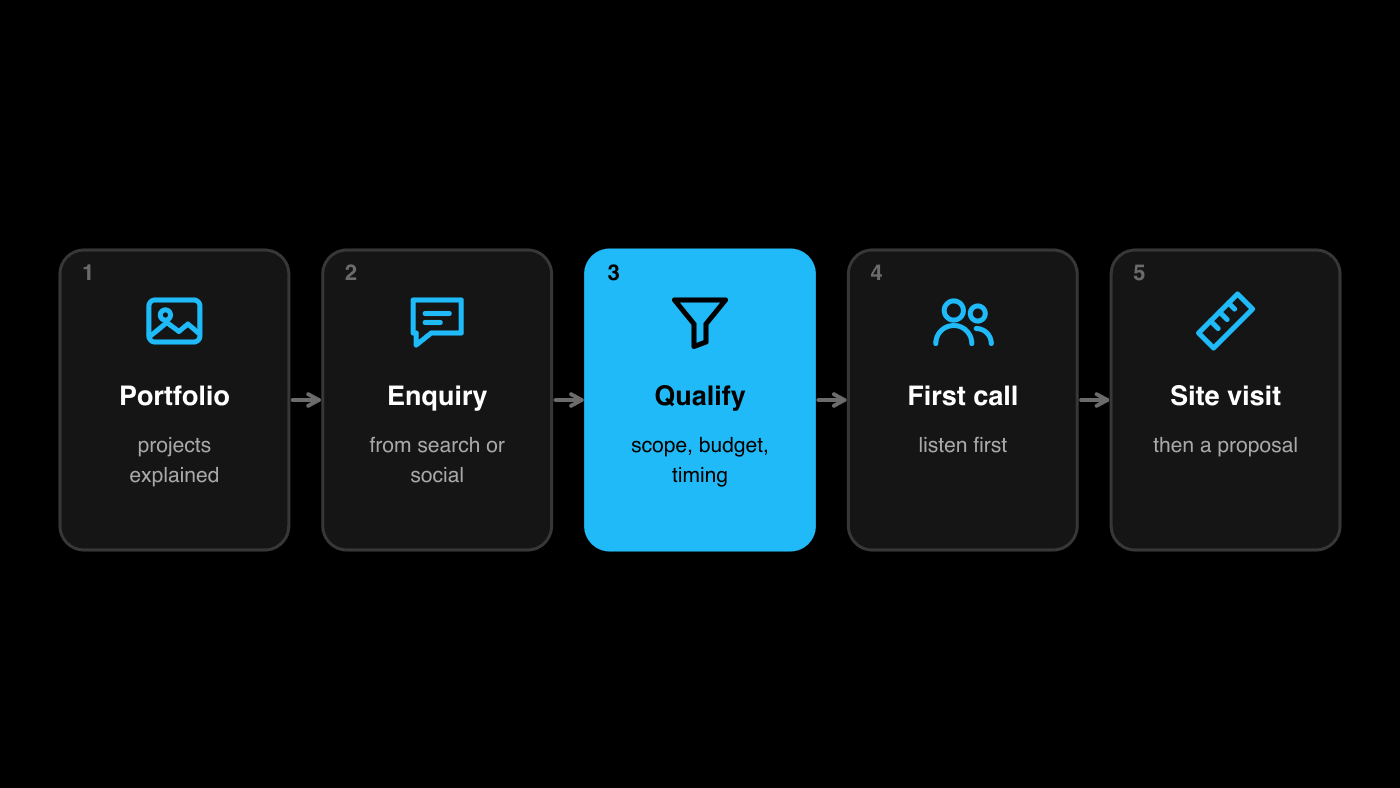
A light qualification step helps both sides. Ask three or four questions in the enquiry form or first chat:
- What kind of space and roughly what size?
- Where is it located?
- What is your approximate budget range for the project?
- When would you like to start?
Explain why you ask: "So we can suggest the right next step." Offer a consultation as the outcome: a call or visit where you learn more and explain your process and fees. If a project is out of scope, refer politely rather than ignoring it.
Do not display prices you cannot honour. If your fees depend on scope, explain how they are set and what a consultation covers.
What should the first conversation look like?
The first call has three goals: understand the project, explain how you work, and agree a next step. Send a short written summary afterwards, with your process and the consultation details. If the client is not ready, ask when to follow up, and do.
How do WhatsApp and phone enquiries fit in?
Many clients prefer to send photos of a space and voice notes. Use WhatsApp Business with a greeting message and a quick reply for how you work. Respond the same day, and keep a simple log of source, project type, budget band and outcome. That log tells you which channels bring projects rather than curiosity.
How do you measure lead quality?
Track: enquiries, qualified enquiries, consultations booked, consultations held, proposals sent and projects won. Add the source to each. Then look at cost per consultation and cost per project, not per message. A campaign that brings fewer but better enquiries usually deserves more budget.
How do you talk about budget and fees without losing good clients?
Money is the awkward part of the first conversation for both sides. Make it easier by explaining structure before numbers.
- Explain how you charge: for example a design fee, then supervision or execution, and what changes the total, such as area, materials and the level of detail.
- Ask for a budget range, not a figure, and say why: it lets you propose something realistic rather than something that will disappoint.
- Say what a consultation covers and whether it is free or paid, so nobody is surprised.
- Send a short proposal after the consultation: the scope you understood, what is included, the phases, the timeline and the next step. It shows professionalism and gives the family something to discuss at home.
- Refer politely when a project is outside your range. A clear "this is not the right fit, here is why" builds a reputation that brings referrals.
Clients rarely mind talking about money. They mind vagueness about it.
A studio scenario (illustrative, not a client result)
Imagine a studio whose Instagram grid is beautiful and whose website is a slideshow. Enquiries are a handful of price questions. The studio rewrites three projects as stories, adds service pages for its main work with locality information, creates a short enquiry form with four qualifying questions, and runs a small search campaign for the two services it most wants.
It receives fewer casual messages. The ones that arrive describe a space, a budget range and a timeline, and lead to consultations. The owner can see which pages and campaigns produced them.
Common mistakes
- A portfolio with no context.
- Copying other designers' captions or using images you do not have rights to.
- Hiding all pricing information and how fees work.
- Sending every enquiry the same reply.
- Paying for clicks without tracking calls and forms.
- Chasing followers instead of consultations.
A checklist for designer leads
- Three to five projects are written as stories with the brief, decisions and result.
- I have service pages specific to what I do and where.
- My Google Business Profile is complete and accurate.
- Ads, if used, use intent keywords, negatives and tracked conversions.
- The enquiry form asks four qualifying questions.
- First response happens the same day.
- I track source, consultation and outcome for each enquiry.
Questions designers ask about online leads
How do interior designers get leads online?
By showing real projects with context, being visible on Google for intent searches, using Instagram to build taste and trust, and making the first conversation simple and structured. Tracking outcomes tells you which channel is worth more effort.
Are Google Ads or Instagram better for interior designers?
They do different jobs. Google Ads capture people already searching for a designer; Instagram builds interest and reassurance. Many studios use both and judge them by consultations and projects.
Should I show prices on my website?
Show how your fees work and what a consultation covers, even if exact prices depend on the project. Clear expectations attract better-fitting clients.
How do I get more high-quality enquiries?
Filter with a short form, describe who you work best with, and write project stories that show your approach. Follow up quickly and record which sources produce good clients.
Can I use photos from other projects or stock images?
Use only work you are entitled to show, and label renders honestly. Presenting others' work as yours is a serious risk to trust and reputation.
The short version
Design clients decide on evidence and comfort. Show real projects with the thinking behind them, be findable when people search and when they browse, ask a few good questions and reply quickly. Then measure by consultations and projects won.
If you want help turning your portfolio and profiles into a lead system, talk to Advertizer. We can look at your website, content, ads and enquiry process together.