
How Automobile Businesses Can Get Local Leads Online
Short answer: Automobile businesses win local leads by separating what customers want: to buy, to service or repair, or to find parts. Give each its own page, Google Business Profile details and tracking, keep addresses and hours exact, and make calling, WhatsApp and directions one tap away. Then measure calls, test drives and service bookings, not visits to a website.
A person choosing a car, a person whose vehicle has broken down and a person looking for a spare part all search near where they are, but they do not want the same thing. A dealership, garage or service centre that treats them as one audience ends up with a generic website that serves none of them well.
How do automobile customers search differently?
| Customer | Typical need | What they check | Best action |
|---|---|---|---|
| Buyer | A vehicle, a test drive, finance options | Models, availability, location, reviews | Book a test drive or visit |
| Service customer | Routine service, repair, urgent help | Distance, hours, trust, price clarity | Call or book a slot |
| Parts shopper | A specific part for a model | Availability, price, location | Call or WhatsApp with the model |
| Used-vehicle shopper | A verified vehicle | Condition, papers, photos | Visit, inspect, ask |
Urgency also differs. Someone with a breakdown searches now and picks the first business that looks close and reachable. Someone buying a vehicle compares over days. Your marketing should respond to both speeds.
Why do local automobile businesses miss leads online?
- One website page tries to cover sales, service and parts.
- The Google Business Profile lists only one category and old hours.
- Calls after hours or on busy days go unanswered.
- WhatsApp is checked irregularly.
- Enquiries are not recorded, so nobody knows which channel produced a sale.
- Ads point at a home page instead of the specific service.
How should you set up Google Business Profile for an automobile business?
Google's help page on local ranking lists relevance, distance and prominence as the signals. For an automobile business, that translates into:
- Choose the primary category that best matches the main business, and add accurate secondary categories.
- If you have separate sales and service departments with different hours or phone numbers, check Google's guidelines for whether they may have separate listings, and follow them exactly.
- Keep hours, holiday timings, phone numbers and address exact, and pin the location correctly.
- Add real photographs of the showroom, workshop, team and work.
- List services clearly, such as periodic service, tyre work, denting and painting, or accessories, as offered.
- Ask genuine customers for reviews and respond to all of them.
If a listing is not appearing, check it against why a local business is not showing on Google.
What should the website do for each type of customer?
Build separate pages, each with one action:
- Sales: models you sell, availability where known, finance information you can offer, and a test-drive booking.
- Service and repair: the services, price guidance where you are willing to give it, service booking, pick-up and drop where available, and a click-to-call button.
- Parts and accessories: how to enquire by model, and how you handle orders.
- Used vehicles (if applicable): honest details and photographs of each vehicle, and how to inspect it.
Every page should show the address, map link, hours, phone number and WhatsApp on the first screen for a phone user. Read our notes on website development for how these pages are built to make one decision easy.
Where do Google Ads and Meta Ads fit?
Google Ads suits high-intent local searches: a specific service or model with a location. Use call assets and location extensions where available, target the area you serve, and send each ad to its matching page. Meta Ads suit launches, offers, festive campaigns, service reminders and awareness in the neighbourhood.
In both cases, track calls, WhatsApp clicks and form submissions as conversions. Google's conversion tracking overview explains how actions such as calls and sign-ups can be recorded. Read more about our performance marketing work.
How should you handle calls and WhatsApp?
For automobile businesses, the phone is often the conversion. Make the channel dependable:
- Answer every call, or return missed calls the same day. Post opening hours honestly.
- Use WhatsApp Business with a greeting, quick replies for service timings and a way to send photos of a problem.
- Give the right person the right enquiry: sales, service or parts.
- Record every enquiry: source, type, vehicle, outcome.
Use customer numbers only for the purpose they were given and respect consent for reminders and promotions.
How do service reminders create repeat business?
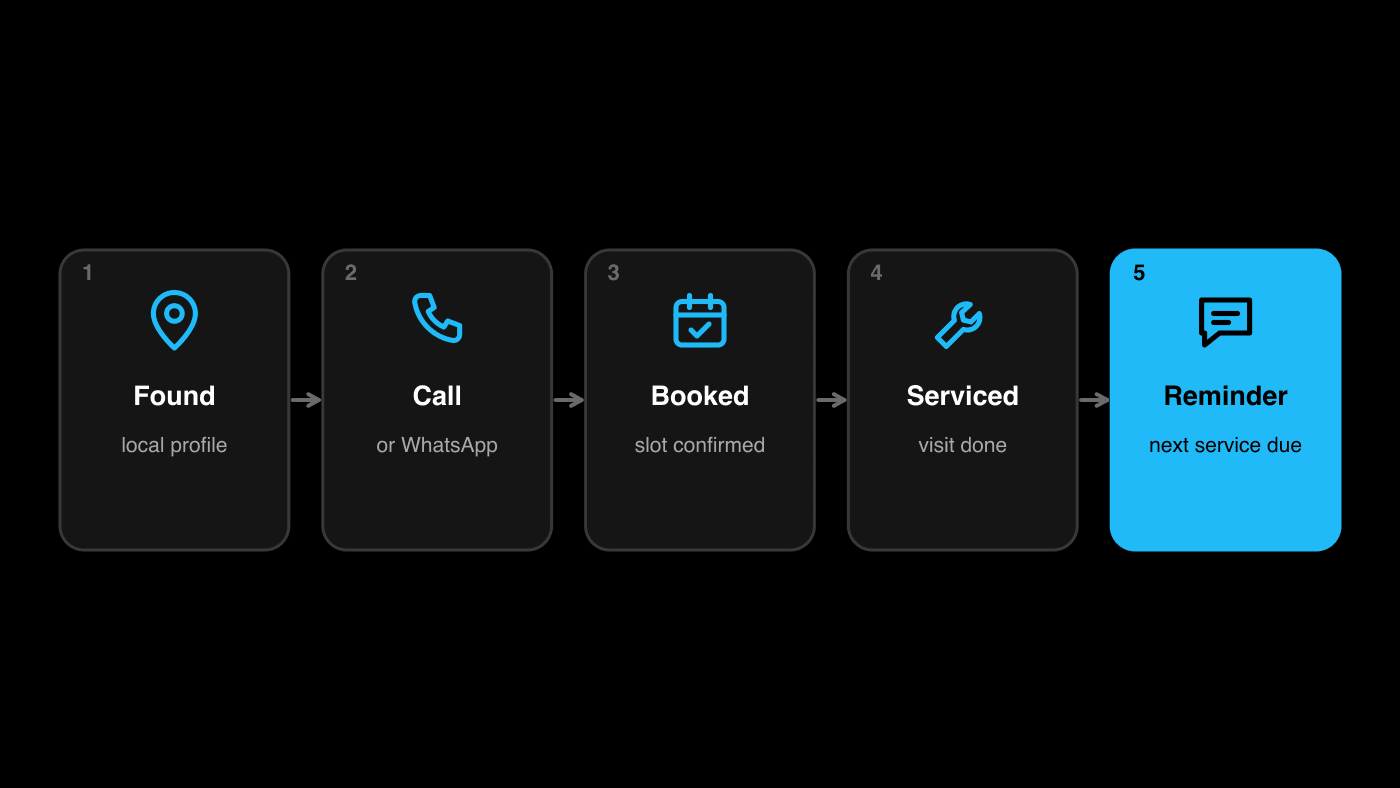
Servicing is repeated. Reminding customers when a service or insurance renewal is due, and making it easy to book, brings them back without paying for new customers. Keep reminders useful, infrequent and permission-based, and offer a single-tap booking link or chat.
How do you measure what works?
Measure by business outcome: calls answered, test drives booked and done, service bookings, parts orders. For each enquiry, record where it came from. Then compare channels: Google profile, website, ads, social media, referrals. Do not judge a channel only by clicks or messages.
What should a service booking ask, and how should offers be shown?
A service booking form should be as short as a phone call. Ask for the vehicle make and model, the kind of service or the problem in the customer's words, a preferred day and time, and a phone number. Ask for nothing you will not use. Confirm the slot in writing, say whether pick-up and drop are available, and send a reminder.
For sales and offers, honesty protects trust:
- Show the vehicles and variants you actually have or can arrange, and say when availability changes.
- If you mention finance or exchange options, state the conditions in plain words, and route detailed terms to a conversation rather than an ad headline.
- Keep prices, offers and end dates current on the website and Business Profile; an expired offer that still shows is a broken promise.
- For used vehicles, show real photographs, the vehicle's details and how a buyer can inspect it.
Every claim on a page should be one your team can stand behind at the counter.
A service-centre scenario (illustrative, not a client result)
Imagine a multi-brand service centre whose website is a single page and whose Google profile lists old hours. It creates separate pages for periodic service, denting and painting and tyre work; updates its profile with correct hours and real photos; adds a click-to-call and WhatsApp button; and sets up a simple log of enquiries. It starts a small local search campaign for periodic service with call tracking.
A customer who searches for a service nearby now finds accurate hours, sees the work and can call or message in one tap. The owner sees which channels produce bookings.
Common mistakes
- One page for every purpose.
- Wrong or outdated hours and phone numbers.
- Slow or missed replies.
- Untracked calls and WhatsApp.
- Spam-style review requests or fake reviews.
- Ads that open a home page.
An automobile lead checklist
- Separate pages exist for sales, service, parts and used vehicles as relevant.
- Google Business Profile has correct hours, categories, photos and services.
- Address, phone and WhatsApp are on every page.
- Calls and messages are answered or returned promptly.
- Ads track calls, forms and WhatsApp as conversions.
- Every enquiry is logged with source and outcome.
- Reminders are permission-based and easy to act on.
Questions automobile businesses ask about local leads
How can a car dealership get more local leads online?
Be findable on Google with an accurate profile, give buyers a specific page and a test-drive action, make calling and messaging easy, and track which channels produce visits and sales.
How can a garage or service centre get more customers?
Make your services, hours and location clear on Google and your website, be reachable by phone and WhatsApp, collect genuine reviews and use reminders to encourage repeat servicing.
Do I need Google Ads for an automobile business?
Not always. A strong profile and website may bring customers, and ads can add demand for specific services. If you use ads, track calls and bookings.
Should sales and service have separate Google listings?
Only if Google's guidelines allow it for your situation. Check the current rules and follow them, because incorrect listings can be suspended.
How do I track leads from WhatsApp?
Use a click-to-chat link on your pages and ads, record each conversation in a log and note the outcome. It is manual but effective.
The short version
Automobile customers search for different things. Serve each with its own page and profile details, make calls and messages effortless, keep reminders permission-based, and measure test drives, service bookings and sales.
If you would like your automobile business's online presence reviewed, talk to Advertizer. We can look at your profile, pages, ads and enquiry handling together.