
How to Sell Banarasi Sarees Online Through Instagram
Short answer: Selling Banarasi sarees on Instagram works when you solve the trust gap: show the weave and colour honestly, describe each piece completely, prove what you claim, and make it easy to ask questions and order on WhatsApp. Reels bring people in, product details and conversations close the sale, and ads amplify what already works.
A Banarasi saree is bought with the eyes and the hands. On a phone screen, the buyer has only your photographs, your words and your reputation. That is why growth on Instagram often stalls: likes are easy, but paying for something that cannot be touched needs a different kind of confidence.
This guide is about building that confidence in a sequence, from the profile to the order. If you prefer marketplaces, our separate guide covers selling Banarasi sarees on Amazon and Flipkart.
Why do saree businesses get likes but few orders?
Most stalled saree accounts have the same four gaps:
- Beautiful posts, thin information. Fabric, weave, zari type, length and price are missing or scattered across comments.
- No proof. Nothing shows who is behind the account, where the sarees come from or what customers say.
- A slow buying path. The buyer has to ask five questions in the DMs and wait a day for each answer.
- Feed content that does not build over time. Each post is a single product, so the account never teaches the buyer anything.
How should a saree business set up its Instagram profile?
Treat the profile as a shop window. In a few seconds a stranger should know what you sell, for whom, and how to buy.
- Name and bio: say what you sell in plain words (for example, the kind of sarees and where you work from) and give one clear action.
- Link: a chat link or a page with your catalogue and contact, not a link that leads nowhere.
- Highlights: organise them as a shop would: new arrivals, wedding, festive, care guide, delivery and returns, customer photos.
- Contact: a business phone or WhatsApp number that is actually monitored.
How do you photograph sarees so they sell?
Photography is the product for an online buyer. A few principles matter more than equipment:
- Use daylight where you can. Colour accuracy is the biggest cause of returns and disappointment, so check that the photo matches the fabric under normal light.
- Show the saree in four views: full drape, close-up of the weave and zari work, the border and pallu, and the fabric in motion.
- Add a reference: a model, a hand, a measuring tape, so scale is clear.
- Keep backgrounds simple so the saree is the subject.
If you need help with product photography and videos, see our product shoot work.
What content makes people trust and buy?
Different content does different jobs. Use them together rather than posting only product photos.
| Content | What it does | Next step to offer |
|---|---|---|
| Product reel (drape, movement) | Gets attention and shows the feel | Ask for details in chat |
| Weave close-ups and process clips | Shows craft and quality | Link to the collection |
| How-to and care guides | Builds trust and saves | Invite questions |
| Customer photos and messages, with permission | Shows real people wearing it | Point to reviews |
| Behind-the-scenes and workshop posts | Shows who is behind the account | Invite followers to visit or message |
| Wedding and festive edits | Meets seasonal demand | Booking or viewing slot |
What must a product post always say?
Give buyers the facts they would ask for, in the same order every time. A consistent template also saves you hours in the inbox.
- Type of saree and fabric (for example silk, cotton-silk, georgette) as you actually know it
- Weave and zari details, described plainly
- Length, width and whether the blouse piece is included
- Colour notes and any variation between screens and reality
- Care instructions
- Price and what it includes
- Delivery time, payment options and return or exchange terms
How do you describe handloom, power loom and authenticity honestly?
Say only what you can prove. If you sell handloom pieces, be able to say who made them and how. If you sell power-loom sarees, say so; many buyers value them for their own reasons. If you mention silk purity, a Silk Mark or any other certification, you should hold the document and be prepared to show it. Do not use words such as "pure", "original" or "authentic" as decoration, and do not display marks or logos you do not have the right to use.
Honest presentation protects you from returns, disputes and damaged reputation, and it sets you apart in a category where buyers have become cautious.
How do you move a buyer from message to order?
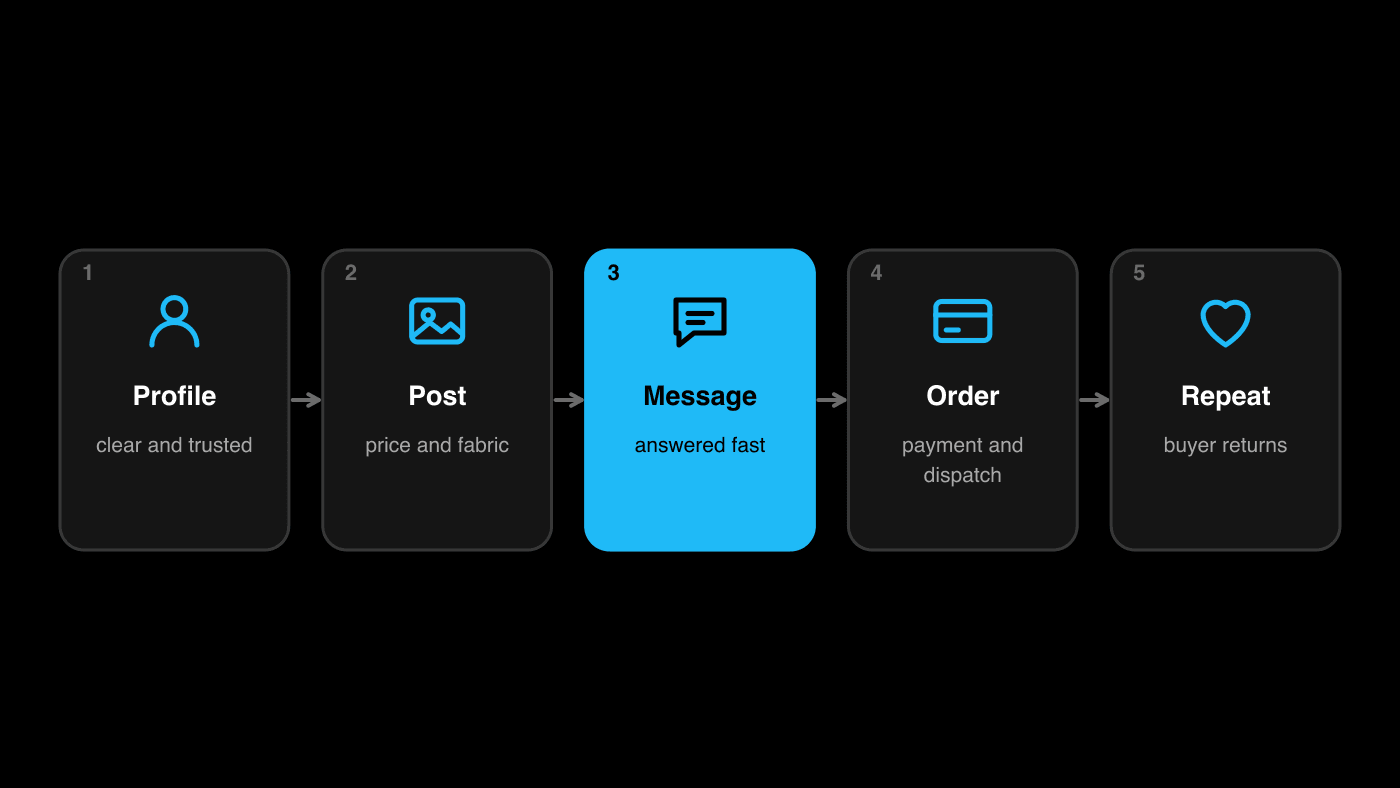
The inbox is where most sarees are sold. Make it smooth:
- Use quick replies for price, availability, delivery and returns.
- Send a short catalogue or set of photos for the pieces the buyer asked about.
- Offer a video call or live video of the saree for higher-priced purchases.
- Confirm details in writing before payment: item, price, delivery date.
- Follow up once, politely, if a buyer goes quiet.
WhatsApp Business features such as a catalogue, labels and greeting messages can help organise this, as long as you use customer contact details with their permission.
Should you run Meta Ads for sarees?
Ads are best used to amplify content that already works: a reel that earned saves and questions, a collection launch, or a festive season push. Show the ad to interested people in the regions you deliver to, send them to a chat or catalogue, and keep the first budget small. Read our Meta Ads services for how campaigns are planned, and start by defining what an order costs you before deciding what you can afford to pay to get one.
Season matters. Festive and wedding periods create demand for particular colours, borders and price points, so plan your content and stock ahead of them.
Instagram, your own website or marketplaces?
They serve different purposes, and many sellers use all three. Instagram builds attention and trust and starts conversations. A website gives you a permanent catalogue, product pages and payments under your control. Marketplaces bring shoppers who are already searching, at the cost of fees and rules. Our guide on digital marketing for saree businesses looks at the wider picture.
A seller's scenario (illustrative, not a client result)
Imagine a Varanasi seller with a beautiful feed and slow sales. Posts show a saree and a price; questions about fabric, blouse piece and delivery arrive one by one. The seller changes three things: each post follows the seven-point template, one reel a week shows the weave close-up and drape, and highlights collect customer photos and delivery terms. A WhatsApp greeting message explains how to order.
The seller does not gain followers overnight. But an interested buyer now gets answers before asking, sees proof that others have bought, and has a direct route to order. That is how trust is created for a product that cannot be touched.
Common mistakes
- Posting product photos with no information.
- Edited colours that do not match the fabric.
- Using terms like "pure handloom" without being able to prove them.
- Answering enquiries a day later.
- No delivery or returns policy.
- Copying other sellers' images or captions.
A saree-selling checklist
- Bio says what I sell and gives one action.
- Highlights cover new arrivals, care, delivery, returns and customer photos.
- Each product shows drape, weave close-up, border and pallu.
- Every product post follows the same information template.
- I can prove every material or authenticity claim I make.
- Quick replies and a WhatsApp greeting are set up.
- I review which posts create questions and orders each month.
Questions saree sellers ask about Instagram
How do I start a saree business on Instagram?
Decide what you sell and to whom, set up a clear profile, photograph pieces honestly, share complete product information, and make ordering easy through chat. Build gradually: consistent content, a reliable buying path and honest promises.
How can I sell handloom Banarasi sarees online?
Show the weave and craft, describe each piece accurately, and be able to prove any handloom or material claims. Combine Instagram for trust and conversation with a website or marketplace for a stable catalogue.
Do I need ads to sell sarees on Instagram?
Not to begin, but ads can amplify content that already earns attention. Keep budgets small at first and judge results by orders, not likes.
How do I stop buyers asking the same questions?
Put the answers in the post: fabric, dimensions, blouse piece, care, price, delivery and returns. Use quick replies and highlights for the rest.
Should I sell on my own website or on marketplaces?
Many sellers use both. Your own site gives control and a permanent catalogue; marketplaces give access to people who are already searching, with fees and rules. See our marketplace guide for that route.
The short version
A saree buyer is buying trust as much as fabric. Show the product honestly and completely, prove what you claim, make questions easy to ask and orders easy to place, and use ads only to amplify what already works.
If you want help with saree photography, content and a buying path that turns messages into orders, talk to Advertizer. We can look at your profile, content and enquiry process together.